


Original source: J&Y Law — Los Angeles Car Accident Attorney
If you were injured in a Los Angeles car accident, California gives you 2 years to file under CCP § 335.1 and lets you recover compensation even if you were partly at fault.
- Statute of limitations: 2 years from the accident date — missing this date permanently bars your claim
- Pure Comparative Negligence: You can recover even if you were partially at fault — your compensation is reduced by your fault percentage, not eliminated
- New minimums as of Jan. 1, 2025: $30,000 per person / $60,000 per accident under AB 1107
- Call 911: An LAPD or CHP report is required for any injury claim
- Do not give a recorded statement to any insurer before speaking with an attorney
California's Pure Comparative Negligence rule means fault is rarely all-or-nothing — your recovery is reduced by your fault percentage, not eliminated.
Contact a Los Angeles car accident attorney before your first insurer call.
Find out if you have a case in Los Angeles
⚡ Free · No Obligation
See If You Qualify in 60 Seconds
Step 1 — Select accident type
What type of accident were you in?
Key Takeaways
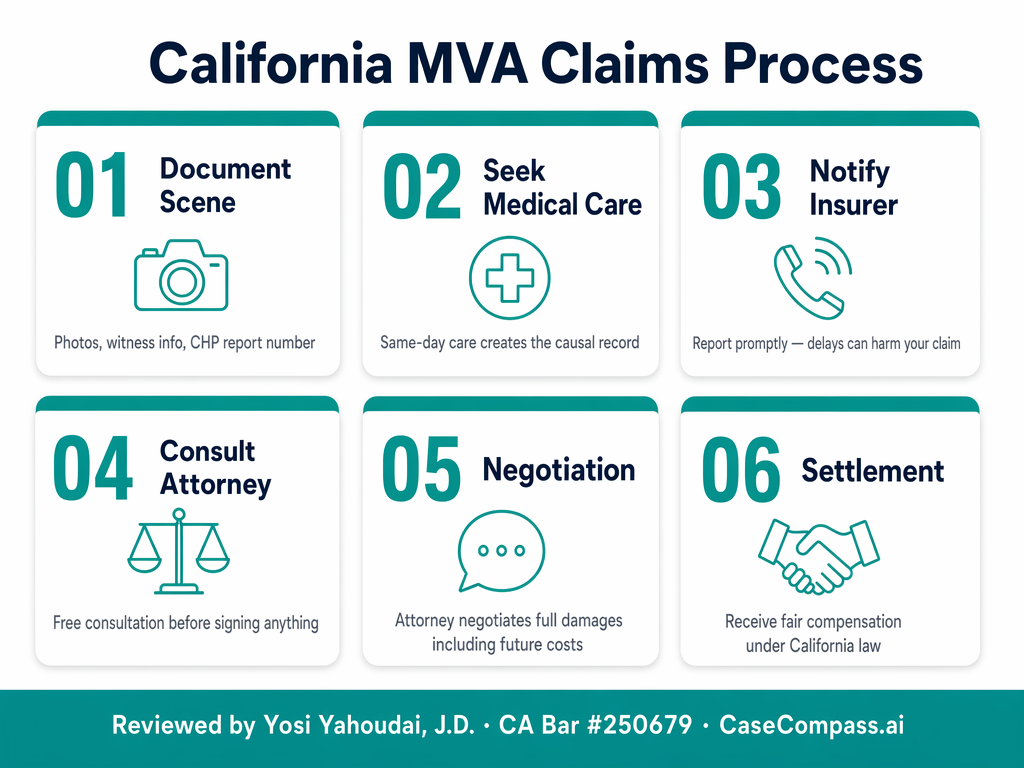
- 1.Call 911 immediately and wait for LAPD or CHP to arrive. In California, any accident with injury must be reported to law enforcement — your police report number is required for every insurance claim and any future lawsuit.
- 2.Photograph everything before moving any vehicle: both cars, all damage, your injuries, the road conditions, traffic signals, skid marks, and the positions of all vehicles. Take a wide-angle photo of the entire scene from multiple angles.
- 3.Get the other driver's full name, license number, insurance company, policy number, vehicle make/model, and license plate. Photograph their insurance card directly rather than writing down the details.
1. Why Los Angeles Car Accident Claims Are Different
2. How California Pure Comparative Negligence Affects Your Case
3. What We See in Practice: Early Offers and MMI Timing
Not sure if your offer is fair?
Answer 3 questions to see what your case may be worth — free, no obligation.
Start Free Case Review →Frequently Asked Questions
What should I do immediately after a car accident in Los Angeles?
Call 911 and wait for the police report. Photograph both vehicles, all damage, your injuries, and the scene. Collect the other driver's insurance information. See a doctor the same day. Do not give a recorded statement to any insurer before speaking with an attorney. California law does not require you to cooperate with the opposing insurer.
How long do I have to file a car accident claim in California?
California gives you 2 years from the accident date to file a personal injury lawsuit under CCP § 335.1. If a city or county vehicle was involved, you may have only 6 months to file a government tort claim. Missing these deadlines permanently bars your right to compensation — contact an attorney as soon as possible.
Can I still recover compensation if the accident was partly my fault?
Yes. California uses Pure Comparative Negligence — you can recover compensation even if you were 99% at fault. Your recovery is simply reduced by your percentage of fault. For example, if you are found 20% at fault in a $100,000 case, you recover $80,000. Insurance companies use this rule aggressively to minimize payouts by inflating the victim's fault share.
What are California's minimum car insurance requirements in 2025?
As of January 1, 2025, under AB 1107, California drivers must carry at least $30,000 per person and $60,000 per accident in bodily injury liability coverage, and $15,000 in property damage liability. These minimums doubled from the previous $15,000/$30,000 limits. If the at-fault driver only carries minimum coverage and your damages exceed those limits, your own underinsured motorist (UIM) coverage can cover the gap.
What if the other driver was uninsured in California?
If you carry Uninsured Motorist (UM) coverage, your own policy covers your injuries up to your UM limits — even when the at-fault driver has no insurance or flees the scene. California requires insurers to offer UM/UIM coverage. If you declined it in writing, your options are limited to pursuing the at-fault driver personally, which is rarely fruitful. An attorney can review your full policy coverage.
Sources and Citations
Ready to find out if you qualify?
⚡ Free · No Obligation
See If You Qualify in 60 Seconds
Step 1 — Select accident type
What type of accident were you in?