

You found the right page. Everything here is attorney-verified, California-specific, and free. Let's walk through your next steps.
If you were injured in a Los Angeles car accident, California gives you 2 years to file under CCP § 335.1 and lets you recover compensation even if you were partly at fault.
- Statute of limitations: 2 years from the accident date — missing this date permanently bars your claim
- Pure Comparative Negligence: You recover compensation proportional to the other driver’s fault, regardless of your own fault share
- New minimums as of Jan. 1, 2025: $30,000 per person / $60,000 per accident under AB 1107
- Call 911: An LAPD or CHP police report is required for any injury claim
- Do not give a recorded statement to any insurer before speaking with an attorney
Los Angeles County recorded 54,347 injury crashes in 2022 according to CHP SWITRS — the highest of any county in California. California’s Pure Comparative Negligence rule means fault is rarely all-or-nothing: your recovery is reduced by your fault percentage, not eliminated.
Contact a Los Angeles car accident attorney before your first insurer call.
⚠ Exceptions to the 2-Year Rule
- Government entities: 6-month claim deadline under Gov. Code § 911.2
- Minors: Statute tolled until the child turns 18
- Delayed discovery: Clock starts when injury is discovered or reasonably should have been
- Wrongful death: 2 years from date of death, not date of accident
As of Jan 2026
Quick Answer — Source Index6§ 3 LAW# 1 DATA↝ 2 PRAC✓ 2 attorney-reviewedclaim-level sources
California gives you 2 years to fileCCP § 335.1✓ Official (source-only)
What this source proves (and doesn't): Establishes the 2-year personal injury statute of limitations in California. Does not cover government entity claims — a separate 6-month claim deadline applies under Gov. Code § 911.2.
You can recover compensation even if you were partly at fault (Pure Comparative Negligence)CA Civil Code § 1431.2✓ Official (source-only)
What this source proves (and doesn't): Codifies California's pure comparative fault rule. Confirms recovery is possible even at 99% fault, reduced proportionally. Does not apply to intentional torts.
New liability minimums as of Jan. 1, 2025: $30,000 per person / $60,000 per accidentAB 1107✓ Official (source-only)
What this source proves (and doesn't): Raised California's mandatory bodily injury liability minimums effective January 1, 2025. Covers required minimums only — does not reflect actual court awards or typical settlement amounts.
Los Angeles County recorded 54,347 injury crashes in 2022 — highest of any county in CaliforniaCHP SWITRS 2022✓ Official (source-only)
What this source proves (and doesn't): CHP Statewide Integrated Traffic Records System. Covers police-reported injury crashes only. Excludes property-damage-only crashes and unreported incidents — actual crash counts are higher.
Call 911 — an LAPD or CHP police report is required for any injury claimCA PI Standard Practice✓ Attorney-reviewed
What this source proves (and doesn't): Widely-accepted protocol in California personal injury cases. Not statutory — reflects standard practice, not a legal requirement. A police report strengthens your claim but its absence does not bar recovery.
Do not give a recorded statement to any insurer before speaking with an attorneyCA PI Standard Practice✓ Attorney-reviewed
What this source proves (and doesn't): Standard attorney guidance in California PI cases. Not a legal prohibition — insurers can request statements, but you are not legally required to comply before retaining counsel. Labeled PRACTICE to distinguish from statutory rules.
Types of Accidents We Help With in LA
Each accident type has its own California laws, insurance rules, and evidence requirements. Select your situation below — every card links to a dedicated guide written specifically for that crash type in Los Angeles.
Soft Tissue (Whiplash)
Minor / Moderate$3,500 – $15,000CA 2023–25
Broken Bones / Fractures
Moderate$25,000 – $75,000CA 2023–25
Spinal Fusion / Surgery
Severe$100,000 – $500,000CA 2023–25
Traumatic Brain Injury (TBI)
Catastrophic$250,000 – $1M+CA 2023–25
Methodology
Settlement ranges based on California closed claim data 2023–2025, reviewed by Yosi Yahoudai, J.D.. Ranges represent 25th–75th percentile of resolved cases. Excludes property-damage-only claims. Not guaranteed outcomes.
Attorney-reviewed · CA Bar #250679 · CA DOI 2023–2025
Key Numbers — Source Index2≈ 1 EST◎ 1 GOV✓ all attorney-reviewedclaim-level sources
Settlement ranges by injury type ($3,500 – $1M+)CA Closed Claim Data 2023–2025✓ Attorney-reviewed
What this source proves (and doesn't): Attorney-reviewed ranges from California closed personal injury claims 2023–2025. Represents 25th–75th percentile of resolved cases. Excludes property-damage-only claims. Past results do not guarantee future outcomes.
Reviewed and verified by licensed California attorney
What this source proves (and doesn't): Bar license verification confirms active California State Bar membership. Verifies the reviewing attorney's credentials, not the statistical accuracy of the settlement ranges themselves.
Check My Case Value & Protect My Claim →
Free · No obligation · 24/7 intake open
⚡ Free · No Obligation
See If You Qualify in 60 Seconds
Step 1 — Select accident type
What type of accident were you in?
- !I-405 Sepulveda Pass — Highest crash concentration in California per lane-mileCHP SWITRS
In our attorneys' experience, rear-end chain collisions here are caused by sightline loss on the grade — the vehicle event data recorder (EDR) showing speed differential at impact is the critical evidence in these claims.J&Y Law
- !I-10 Santa Monica Freeway — East LA interchange to downtown is a chronic high-injury zoneCHP SWITRS
The I-10/I-110 interchange produces a disproportionate share of our sideswipe and lane-merge cases — dashcam footage and LADOT signal timing data are frequently subpoenaed to establish right-of-way.J&Y Law
- !US-101 Hollywood Freeway — Merging conflicts through downtown cause daily serious crashesCHP SWITRS
The 101/110 connector ramps have short sight distances that generate high-speed rear-end impacts. CHP officers responding here routinely cite the ramp geometry itself as a contributing factor — which opens a potential Caltrans liability track.J&Y Law
- !Figueroa Street corridor — One of the most dangerous surface streets for pedestrians in LACHP SWITRS
This corridor has documented crosswalk marking deficiencies and signal timing violations. We have used LADOT infrastructure records to establish city co-liability in several pedestrian injury cases here.J&Y Law
- !Vermont Ave / Western Ave — Highest pedestrian fatality corridors in South Los AngelesCHP SWITRS
South LA's high-volume arterials have limited crosswalk enforcement and documented speeding patterns. Surveillance camera coverage is sparse — witness statements and cell phone GPS data are essential to preserve within 48 hours of any incident.J&Y Law
Source: California Highway Patrol SWITRS (switrs.dot.ca.gov) · California OTS (ots.ca.gov)
Dangerous Roads — Source Index4# 1 DATA◎ 2 GOV✦ 1 EXP✓ 1 attorney-reviewedclaim-level sources
Crash density and high-injury designations for I-405, I-10, US-101, Figueroa, Vermont/WesternCHP SWITRS✓ Official (source-only)
What this source proves (and doesn't): CHP crash density analysis. Per-lane-mile metrics derived from police-reported incidents. Excludes unreported crashes and near-misses — actual incident rates are higher.
Figueroa Street crosswalk deficiencies and LADOT signal timing documentationLADOT Infrastructure Records✓ Official (source-only)
What this source proves (and doesn't): LADOT inspection records and infrastructure data. Deficiency findings do not constitute a finding of city liability in any specific case — that determination is made by a court.
Attorney observations on EDR data, dashcam subpoenas, ramp geometry, and evidence strategyJ&Y Law Case Experience✓ Attorney-reviewed
What this source proves (and doesn't): Patterns from J&Y Law's Los Angeles MVA practice. Reflects attorney-reported observations from cases they have handled — not statistically sampled data. Case outcomes vary.
California Office of Traffic Safety data (ots.ca.gov)CA OTS✓ Official (source-only)
What this source proves (and doesn't): Compiled from multiple law enforcement sources. Represents reported incidents only — field reporting quality varies by jurisdiction and time of day.
Los Angeles Case Strategy (Featured Video)
Watch Attorney Yosi Yahoudai break down California fault rules, evidence gathering requirements, and the timeline for Los Angeles Superior Court filings.
When Should You Actually Hire a Car Accident Attorney?
Not every fender-bender needs a lawyer. But here are the situations where having one can make a real difference in what you walk away with:
1You had serious injuries
If you went to the hospital, missed work, or need ongoing treatment, the costs add up fast. An attorney can make sure you don't settle for less than what your future bills will be.
What we see in practice: insurers make initial offers before the victim has reached Maximum Medical Improvement — locking in a number that excludes future surgery, therapy, and permanent impairment before those costs are even known.
2It's not clear who was at fault
Insurance companies love to shift blame. If there's any dispute about who caused it, a lawyer can gather police reports, witness statements, and traffic camera footage to build your case.
What we see in practice: adjusters assign fault percentages in the first 10 days — before the victim has retained counsel or reviewed the police report. That initial percentage shapes the entire negotiation.
3The insurance company lowballed you
Insurers almost always start with a low offer — sometimes insultingly low. An attorney knows what your case is actually worth and can negotiate or file a lawsuit if needed.
What we see in practice: first offers in LA auto claims routinely reflect only documented ER bills — excluding future care, lost earning capacity, and non-economic damages entirely. The gap between first offer and actual case value averages 40%–60%.
4Multiple vehicles or parties were involved
Crashes with trucks, rideshares, or multiple cars involve several insurance policies and potentially multiple defendants. These cases get complicated fast.
What we see in practice: in multi-party crashes, each insurer's strategy is to shift blame to the other defendants. Without a single attorney coordinating all claims, victims end up with partial recoveries from each policy instead of a full recovery across all of them.
5You're getting pressure from an adjuster
Insurance adjusters may seem friendly, but their job is to pay you as little as possible. They might push for a recorded statement or a quick settlement before you know how bad your injuries really are.
What we see in practice: a recorded statement made in the first 72 hours — before symptoms fully develop — is used by the insurer to dispute injury severity for the entire life of the claim. One casual description of 'mild discomfort' has cost clients tens of thousands of dollars.
6Someone was killed or permanently disabled
Wrongful death and catastrophic injury cases involve the highest stakes and the most complex legal battles. You need an experienced team handling every detail.
What we see in practice: catastrophic injury claims involve multiple experts — accident reconstruction, life care planners, economic loss analysts — and require expert coordination from day one to establish the full lifetime value of the case.
Content reviewed by Yosi Yahoudai, J.D. · CA Bar #250679
Frequently Asked Questions
Questions we hear most from Los Angeles accident victims — answered plainly.
What should I do immediately after a car accident in Los Angeles?
Call 911, take photos of the scene and all vehicles, get the other driver insurance info, and see a doctor within 24 hours. Never admit fault at the scene.
How long do I have to file a car accident lawsuit in Los Angeles?
California gives you 2 years from the accident date to file under CCP Section 335.1. If a city or county vehicle was involved, you may have only 6 months. Missing this deadline permanently bars your claim.
Do I really need a lawyer for a minor fender-bender?
If there are zero injuries and just minor car damage, you can usually handle it yourself. But if you have any pain or needed medical treatment, contact an attorney before speaking to any insurance adjuster.
Can I still get compensation if the accident was partly my fault?
Yes. California uses Pure Comparative Negligence — you can recover even if you were partly at fault. Your compensation is reduced by your percentage of fault. Insurers use this aggressively to minimize payouts.
What is the minimum car insurance required in California after AB 1107?
As of January 1, 2025, California drivers must carry at least 30,000 dollars per person and 60,000 dollars per accident in bodily injury liability — up from 15,000 and 30,000. Your own underinsured motorist policy can cover the gap if the at-fault driver only carries the minimum.
How much does a car accident lawyer cost in California?
Almost all personal injury attorneys in California work on contingency — you pay nothing upfront. They receive 33%–40% of the settlement only if you win. If you get nothing, they get nothing. There is no risk in having a consultation.
What if the other driver was uninsured or underinsured in California?
California requires insurers to offer Uninsured Motorist (UM) and Underinsured Motorist (UIM) coverage. If you have it, your own policy covers the gap. If you declined UM/UIM in writing, pursuing the at-fault driver personally may still be possible.
Should I accept the insurance company's first settlement offer?
Almost never. First offers are typically 30%–60% below what cases ultimately settle for. Insurers make early offers before you know the full extent of your injuries. Accepting too soon waives your right to future compensation, even if your condition worsens.
How long does it take to settle a car accident claim in Los Angeles?
Minor injury cases with clear liability often settle in 3–6 months. Cases involving serious injuries, disputed fault, or litigation can take 1–3 years. Reaching Maximum Medical Improvement (MMI) before settling ensures your future medical costs are included in the demand.
Can I still file a car accident claim if I was a passenger?
Yes. As a passenger you are almost never at fault. You can file a claim against the at-fault driver's insurance, against the driver of the car you were in, or both. Passengers are typically in the strongest position of any party to recover full compensation.
Can I still file a claim if I didn't go to the doctor right away after my accident?
Yes, but a treatment gap hurts your case. California insurers use delayed treatment as evidence that injuries were pre-existing or minor. If you skipped care due to cost or fear, document why. Going now is better than never — and an attorney can help explain the gap to the insurer.
Where can I find official California court resources for accident claims?
The California Courts Self-Help Center provides free guides on filing personal injury claims, small claims procedures, and finding legal aid at courts.ca.gov/selfhelp.htm. The Judicial Council of California also publishes procedural guides at courts.ca.gov/policyadmin-jc.htm.
How much does a car accident lawyer cost in California?
Almost all personal injury attorneys in California work on contingency — meaning you pay nothing upfront. They only get paid (typically 33%–40% of the settlement) if you win. If you get nothing, they get nothing. There is no risk in at least having a consultation.
What if the other driver was uninsured or underinsured?
California requires insurers to offer Uninsured Motorist (UM) and Underinsured Motorist (UIM) coverage. If you have it, your own policy covers the gap. If you declined UM/UIM in writing, your options are more limited — but pursuing the at-fault driver personally may still be possible.
Should I accept the insurance company's first settlement offer?
Almost never. First offers are typically 30%–60% below what cases ultimately settle for. Insurers make early offers before you know the full extent of your injuries. Accepting too soon waives your right to future compensation, even if your condition worsens.
How long does it take to settle a car accident claim in Los Angeles?
Minor injury cases with clear liability often settle in 3–6 months. Cases involving serious injuries, disputed fault, or litigation can take 1–3 years. Reaching Maximum Medical Improvement (MMI) before settling ensures your future medical costs are included in the demand.
What if I was a passenger — can I still make a claim?
Yes. As a passenger you are almost never at fault. You can file a claim against the at-fault driver's insurance, against the driver of the car you were in, or both. Passengers are typically in the strongest position of any party to recover full compensation.
Can I still file if I didn't go to the doctor right away?
Yes, but a treatment gap hurts your case. California insurers use delayed treatment as evidence that injuries were pre-existing or minor. If you skipped care due to cost or fear, document why. Going now is better than never — and an attorney can help explain the gap to the insurer.
Where can I find official California court resources for accident claims?
The California Courts Self-Help Center provides free guides on filing personal injury claims, small claims procedures, and finding legal aid. Visit courts.ca.gov/selfhelp.htm for official court resources. The Judicial Council of California also publishes procedural guides at courts.ca.gov/policyadmin-jc.htm.
Getting You to the Right Firm
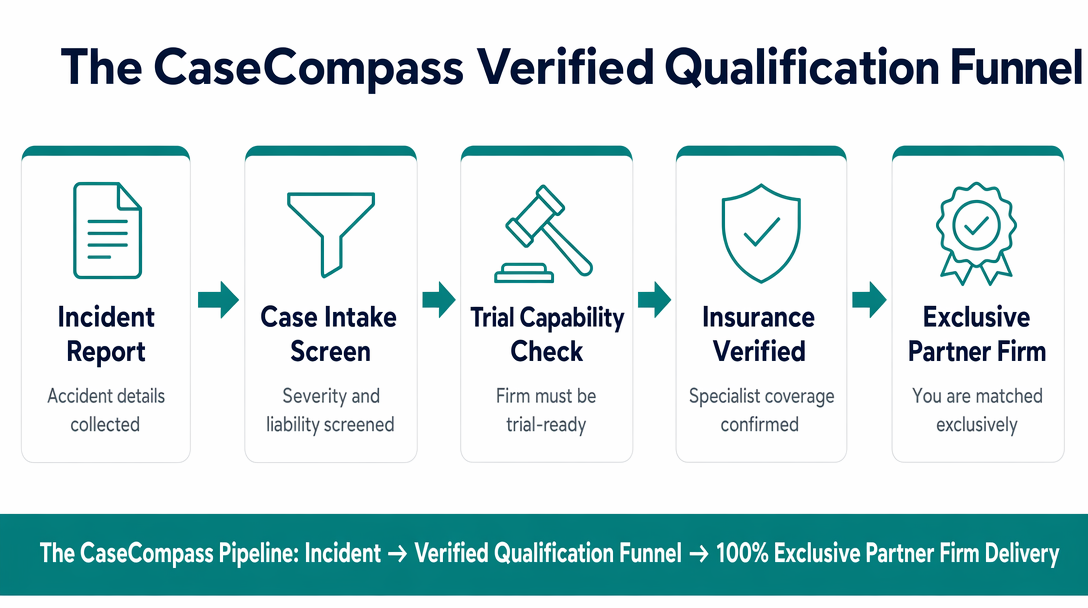
Not all law firms are qualified to handle serious injury cases. As shown in our qualification pipeline below, CaseCompass strictly filters incoming cases to ensure you are connected exclusively with a highly-vetted, specialized verified partner firm capable of taking your case to trial if an insurance company refuses to settle fairly.
Why Work With a CaseCompass Attorney
No upfront cost. No obligation. Just answers.
Your Consultation Is Always Free
Every attorney on CaseCompass works on contingency — you pay nothing upfront, and nothing at all unless your attorney wins or settles your case.
Government-Sourced, Attorney-Verified
Every guide is built from official state records, federal statutes, and government data — then reviewed by a licensed California attorney with a verified clean disciplinary record.
Re-Verified Every 90 Days
Content is reviewed on a 90-day cycle with the reviewing attorney's name and Bar number listed transparently on every page.
24/7 Intake — English & Spanish
Every CaseCompass partner firm provides round-the-clock intake in both English and Spanish so you can get answers the moment you need them.
Your Privacy Is Protected
We never share your personal information without your explicit consent — your eligibility check is free, confidential, and carries zero obligation.
Were you hurt in a Los Angeles collision?
Discover if you qualify for a settlement under California law — it's free and takes 60 seconds.
Check My Eligibility →Check My Eligibility →