


Original source: Our Legal Team — Los Angeles Pedestrian Accident Lawyers
If you were hit by a car in Los Angeles, California law requires every driver to yield to pedestrians at all crosswalks — marked and unmarked — under CVC § 21950.
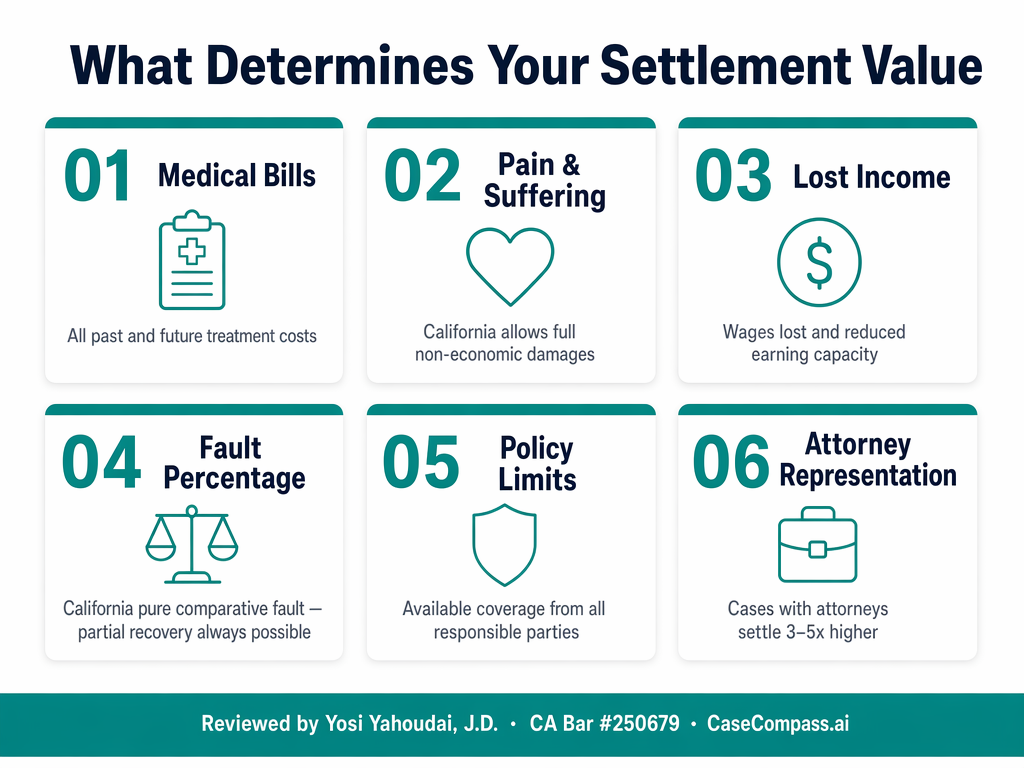
- Jaywalking does not bar recovery: California's pure comparative negligence rule lets you recover even if you were partially at fault
- Government vehicles: Claims against a city or county vehicle must be filed within 6 months under California Government Code § 911.2
- Standard deadline: 2 years under CCP § 335.1
- Document everything: Photos, witness names, and intersection camera footage expire within 48–72 hours
Los Angeles recorded 170 pedestrian fatalities in 2024, according to LAPD Traffic Division data. Pedestrian cases often involve disputed fault — your percentage of fault directly reduces your damages.
Consult an attorney before making any statement about how the crash occurred.
Find out if you have a case in Los Angeles
⚡ Free · No Obligation
See If You Qualify in 60 Seconds
Step 1 — Select accident type
What type of accident were you in?
Key Takeaways
- 1.Call 911 from the scene. Do not let the driver leave without a police report. Pedestrian accident scenes are frequently disputed — the driver's account and yours will differ, and the police report is the primary neutral record.
- 2.Photograph everything: your injuries, your position in the roadway, the vehicle, the driver's license plate, crosswalk markings (or lack of them), traffic signals, and any surveillance cameras on nearby buildings or traffic poles.
- 3.Get witness contact information immediately — bystanders disperse quickly after pedestrian accidents. A single witness who saw the driver's behavior (speeding, running a red light, using a phone) can be the difference between a disputed claim and a clear liability case.
1. The Fault Inflation Play Insurers Run on Pedestrian Cases
2. Jaywalking Does Not Bar Recovery in California
3. The Evidence That Converts a Disputed Case to Clear Liability
4. The 48-Hour Evidence Window After a Pedestrian Crash
Not sure if your offer is fair?
Answer 3 questions to see what your case may be worth — free, no obligation.
Start Free Case Review →Frequently Asked Questions
Can I recover compensation if I was jaywalking when I was hit?
Yes. California's Pure Comparative Negligence law allows you to recover compensation regardless of your share of fault. If you were 30% at fault for jaywalking and the driver was 70% at fault for speeding, you recover 70% of your total damages. Your attorney presents evidence to minimize your assigned fault percentage during settlement negotiations.
Does a driver have to yield to pedestrians in all crosswalks in California?
Yes. California Vehicle Code § 21950 a) requires drivers to yield to pedestrians at every marked crosswalk and every unmarked crosswalk at an intersection. An unmarked crosswalk is the extension of a sidewalk across any intersection, whether or not painted lines are visible. Failure to yield is a moving violation that establishes fault in a personal injury claim.
What is an unmarked crosswalk and does it protect pedestrians in California?
An unmarked crosswalk exists at every intersection where sidewalks meet — even if no paint is visible on the road. California Vehicle Code § 275 defines crosswalks to include these unmarked extensions. Pedestrians crossing within an unmarked crosswalk at an intersection have the same right-of-way protections as those in a painted crosswalk.
What if the driver claims they did not see me?
Failing to see a pedestrian does not eliminate a driver's legal duty to yield. California law imposes a duty of reasonable care on all drivers, including maintaining appropriate speed and attention in pedestrian-heavy areas. Surveillance camera footage, traffic signal timing data, and witness accounts often contradict drivers' claims that they did not see the pedestrian.
How long do I have to file a pedestrian accident claim in California?
2 years from the accident date under CCP § 335.1. If the driver was a government employee in a city or county vehicle, you may have as little as 6 months to file a government tort claim under California Government Code § 911.2. Contact an attorney immediately if a government vehicle was involved.
Sources and Citations
- California Pedestrian Right-of-Way — Vehicle Code § 21950
- California Crosswalk Definition — Vehicle Code § 275
- California Statute of Limitations — [CCP § 335.1](https://leginfo.legislature.ca.gov/faces/codes_displaySection.xhtml?sectionNum=335.1.&lawCode=CCP)
- California OTS — Pedestrian Safety Data
- HCUP — Emergency Department Cost Data
Ready to find out if you qualify?
⚡ Free · No Obligation
See If You Qualify in 60 Seconds
Step 1 — Select accident type
What type of accident were you in?