


Accidents move fast. This guide doesn't. Every step below is attorney-reviewed and specific to Atlanta, Georgia law — so you don't miss what matters.
Verify the attorney before you sign anything. Georgia issues true bar numbers — every active GA attorney has one, and you can confirm status (Active / Inactive / Suspended) at the State Bar of Georgia public directory in 30 seconds.
- Verify GA Bar status: Search gabar.reliaguide.com — confirm the registration number, year admitted, and 'Active Member in Good Standing' status
- Demand specific trial-experience numbers: how many Georgia PI cases tried to verdict in the past 5 years, not 'years of experience'
- Read the engagement letter line by line: Georgia Rules of Professional Conduct (GRPC) Rule 1.5(c) requires the contingency fee, expense responsibility, and post-settlement allocation to be in writing
- Walk away if you were solicited at the hospital or by a runner: O.C.G.A. § 33-24-53 prohibits direct in-person/phone solicitation of accident victims for 30 days after the accident — both the runner and the firm face criminal charges
- Consult at least two firms before signing — this is your single biggest leverage point
Check My Case Value & Protect My Claim →
Free · No obligation · 24/7 intake open
⚡ Free · No Obligation
See If You Qualify in 60 Seconds
Step 1 — Select accident type
What type of accident were you in?
Atlanta's car accident legal market is dominated by high-volume billboard firms. Most viable cases are settled before trial, so adjusters know which firms file lawsuits and which fold at the first denial. The single biggest predictor of recovery is whether your attorney has actually tried Georgia personal-injury cases under O.C.G.A. § 51-12-33 — not how often you've seen the firm on television.
Why This Matters — And What Insurers Won't Tell You
Georgia is a **modified comparative fault** state under O.C.G.A. § 51-12-33 — if you're 50% or more at fault, you recover **nothing**. Insurance adjusters know this and routinely push fault percentages toward 50% in the first 10 days. An attorney who tries cases in DeKalb State Court or Fulton State Court has an apportionment record that adjusters factor into their reserve calculations from day one.
The State Bar of Georgia mandates **written contingency-fee agreements** under GRPC Rule 1.5(c). Verbal-only fee arrangements are unenforceable, and a firm that won't put the fee structure on paper is a firm that doesn't follow the rules they're paid to know.
Georgia's anti-runner statute, O.C.G.A. § 33-24-53, criminalizes direct in-person or phone solicitation of accident victims by attorneys (or runners working for them) for 30 days after the accident — first offense is a misdemeanor; subsequent offenses become felonies. If a 'case manager' or 'medical liaison' contacts you in the ER, walk away and file a complaint with the State Bar's Office of the General Counsel.
Georgia attorneys must keep contingency fee agreements in writing under GRPC Rule 1.5(c) — verbal-only fee arrangements are unenforceable.
GRPC Rule 1.5(c) requires the writing to disclose: the contingency percentage, who is responsible for case expenses (win or lose), and the method of computing the fee from the gross or net recovery. Without all three, a fee dispute breaks the firm's way at the State Bar — not yours.
Source: Georgia Rules of Professional Conduct Rule 1.5
Were you hurt in this type of accident?
Find out if you may be entitled to compensation — it's free and takes 60 seconds.
Check My Eligibility →What To Do Next
- 1
**Verify** the GA Bar status at gabar.reliaguide.com before your first call. Search by name; the result returns the bar number, year admitted, and current standing. If status is anything other than 'Active Member in Good Standing,' ask why before scheduling a consultation.
- 2
**Demand** specific trial numbers in Georgia state court: cases tried to verdict in the past 5 years, named opposing counsel, and the verdict amount or the apportionment percentage assigned. 'I have 25 years of experience' is not a trial record.
- 3
**Read** the engagement letter against GRPC Rule 1.5(c). Confirm the contingency percentage (33⅓% pre-suit / 40% post-suit is standard), who pays case expenses if you lose, and how the fee is computed from gross vs. net.
- 4
**Walk away** if anyone solicits you at the hospital, calls within 30 days, or shows up at the crash scene under O.C.G.A. § 33-24-53. Both the runner and the supervising attorney face criminal liability — and any case built on that solicitation can be subject to disgorgement of fees.
- 5
**Consult** at least two firms before signing. Bring the police report, all insurance correspondence, and your medical records to each consultation — note who explains comparative fault under O.C.G.A. § 51-12-33 in their own words.
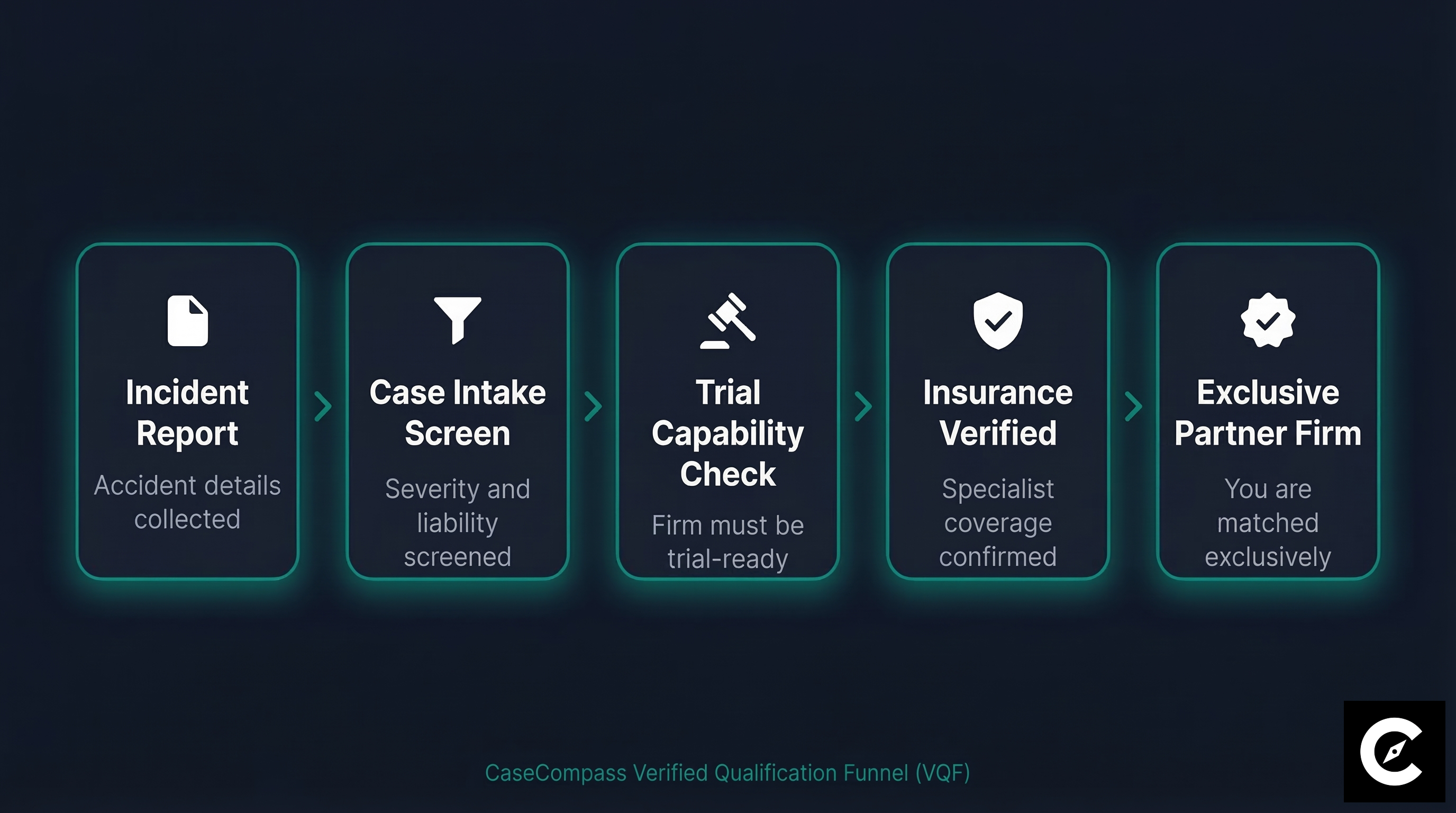
How We Match You with a Verified Firm
Not all law firms are qualified to handle serious injury cases. As shown in our qualification pipeline below, CaseCompass strictly filters incoming cases to ensure you are connected exclusively with a highly-vetted, specialized verified partner firm capable of taking your case to trial if an insurance company refuses to settle fairly.
How much is your case worth in Georgia?
Statewide settlement data by injury type, verified by Seth Bader, J.D..
| Metric | Value | Source |
|---|---|---|
| Modified comparative fault threshold (recover nothing at this percentage) | 50% — your fault must stay below this | [O.C.G.A. § 51-12-33](https://law.justia.com/codes/georgia/title-51/chapter-12/article-2/section-51-12-33/) |
| Georgia anti-solicitation cooling-off period | 30 days post-accident before in-person/phone solicitation is legal | O.C.G.A. § 33-24-53 |
| Standard plaintiff PI contingency range | 33⅓% pre-suit / 40% post-suit (must be in writing) | [GRPC Rule 1.5(c)](https://www.gabar.org/Handbook/index.cfm?action=handbook&doc=12) |
| Georgia personal injury statute of limitations | 2 years from accident date | [O.C.G.A. § 9-3-33](https://codes.findlaw.com/ga/title-9-civil-practice/ga-code-sect-9-3-33/) |
Common Mistakes to Avoid
- 1
**Confusing TV ad spend with case results.** Heavy advertising means a firm can find clients
it tells you nothing about who actually tries cases. Ask for verdict reports under O.C.G.A. § 51-12-33 apportionment, not billboard counts.
- 2
**Hiring an 'intake attorney' you'll never see again.** Many high-volume Georgia firms pair you with a sales-trained intake lawyer at signing, then hand the file to a junior associate who handles 200+ open files. Confirm in writing which attorney personally signs your demand letters and shows up at mediation.
- 3
**Skipping the engagement-letter line on case expenses.** GRPC 1.5(c) lets firms pass case expenses (court reporters, expert witnesses, medical-record retrieval) on to the client, win or lose. A 40% fee on the gross recovery + $15,000 in unrefunded expenses is materially worse than a 40% fee on the net.
- 4
**Letting a 'medical liaison' direct your treatment.** Some Georgia firms route clients to specific clinics tied to litigation lien arrangements. That can violate the 30-day rule under O.C.G.A. § 33-24-53 if the contact happened too early
and Georgia courts can disallow inflated medical bills under O.C.G.A. § 51-12-1.1 (Hospital Lien statute) when treatment is determined to be excessive.
Why Work With a CaseCompass Attorney
No upfront cost. No obligation. Just answers.
Your Consultation Is Always Free
Every attorney on CaseCompass works on contingency — you pay nothing upfront, and nothing at all unless your attorney wins or settles your case.
Government-Sourced, Attorney-Verified
Every guide is built from official state records, federal statutes, and government data — then reviewed by a licensed California attorney with a verified clean disciplinary record.
Re-Verified Every 90 Days
Content is reviewed on a 90-day cycle with the reviewing attorney's name and Bar number listed transparently on every page.
24/7 Intake — English & Spanish
Every CaseCompass partner firm provides round-the-clock intake in both English and Spanish so you can get answers the moment you need them.
Your Privacy Is Protected
We never share your personal information without your explicit consent — your eligibility check is free, confidential, and carries zero obligation.
More Help
How to Get Your Accident Report
Step-by-step guide to requesting your Georgia crash report from GSP or the GSCCCA crash portal.
Find a Trusted Auto Body Shop
Vetted collision repair shops in Atlanta — insurance-approved and independently rated.
Lowball Settlement Offers
How to detect and counter a lowball insurance offer after your accident in Georgia.
Insurance Claim Denied?
Steps to take when your insurer denies or undervalues your claim — including O.C.G.A. § 33-4-6 bad faith.
Frequently Asked Questions
How do I verify a Georgia attorney's bar number?▼
Search the State Bar of Georgia public directory at gabar.reliaguide.com by name. The result returns the registration number, year admitted, current standing (Active / Inactive / Suspended), and firm of record. Status of 'Active Member in Good Standing' is what you need — anything else is a red flag worth investigating before retention.
What's a fair contingency fee in a Georgia car accident case?▼
Standard plaintiff PI contingency in Georgia is 33⅓% pre-suit and 40% post-suit (after a lawsuit is filed). GRPC Rule 1.5(c) requires the percentage, who pays expenses if you lose, and the gross-vs-net method to be in the engagement letter. Anything materially above that range without justification — or any verbal-only arrangement — should make you walk.
Is it legal for a lawyer to contact me after my accident in Georgia?▼
Not for 30 days after the accident under O.C.G.A. § 33-24-53. Direct in-person, phone, or live-text solicitation by attorneys or runners working for them is criminalized for the first 30 days. Mailings are different — those are governed by GRPC Rule 7.3 (anti-solicitation) and require a 'Advertising Material' notation. If a firm or its 'case manager' calls you in the ER, file a complaint with the State Bar Office of the General Counsel.
Should I sign with the first firm I meet?▼
Almost never. Georgia gives you 2 years from the accident date under O.C.G.A. § 9-3-33 — there's no urgency to sign within 24 hours. Consult at least two firms before signing. Bring the police report and all insurance correspondence to each meeting, and ask each attorney to explain comparative-fault apportionment in their own words. The quality of those answers tells you who has actually tried Georgia PI cases.
What if my attorney won't return my calls after I sign?▼
Communication failures are the most common attorney-discipline complaint in Georgia. Document every unanswered call/email in writing. After 14 days of non-response, send a certified letter to the firm asking for a status update. If still ignored, you can file a complaint with the State Bar's Office of the General Counsel at gabar.org or terminate the engagement under your written agreement (you may owe a quantum meruit fee for work performed).
Sources & Citations
- [1] O.C.G.A. § 51-12-33 — Modified Comparative Fault ↗
- [2] O.C.G.A. § 33-24-53 — Anti-Solicitation (30-day cooling-off) ↗
- [3] Georgia Rules of Professional Conduct Rule 1.5 — Fees ↗
- [4] O.C.G.A. § 9-3-33 — Statute of Limitations ↗
- [5] State Bar of Georgia — Member Directory (ReliaGuide) ↗
- [6] State Bar of Georgia — File a Grievance ↗
Check My Case Value & Protect My Claim →
Free · No obligation · 24/7 intake open
⚡ Free · No Obligation
See If You Qualify in 60 Seconds
Step 1 — Select accident type
What type of accident were you in?