


Accidents move fast. This guide doesn't. Every step below is attorney-reviewed and specific to New York City, New York law — so you don't miss what matters.
Truck accidents are among the most valuable and complex personal injury cases in New York. Federal Motor Carrier Safety Administration (FMCSA) rules require commercial carriers operating in interstate commerce to carry a minimum of $750,000 in liability coverage — significantly higher than the $25k/$50k NY minimum for personal vehicles. Many interstate carriers carry $1M–$5M+ in coverage.
Key points:
- NY no-fault PIP still applies — file NF-2 within 30 days
- Serious injury threshold still required to sue for pain/suffering
- The trucking company and its employer/owner may both be liable (respondeat superior)
- Black box (EDR) data is typically overwritten within 30 days — preservation is time-critical
- Hours-of-service violations are a powerful liability argument in federal court
Check My Case Value & Protect My Claim →
Free · No obligation · 24/7 intake open
⚡ Free · No Obligation
See If You Qualify in 60 Seconds
Step 1 — Select accident type
What type of accident were you in?
Your Truck & 18-Wheeler Accidents
Tap each step as you complete it — your progress saves automatically.
The Brooklyn-Queens Expressway (BQE), the Cross Bronx Expressway (I-95), and the approach roads to the Lincoln and Holland Tunnels carry some of the densest commercial truck traffic in the United States. New York City's density, narrow lanes, and complex intersection geometry create outsized injury risk when an 80,000-pound commercial vehicle is involved. Truck accident cases in NYC involve federal FMCSA regulations, the trucking company's commercial carrier, and New York's no-fault system simultaneously.
Why This Matters — And What Insurers Won't Tell You
The single most time-critical step in a NYC truck accident case is preserving the truck's electronic data. Commercial trucks are required to have Electronic Logging Devices (ELDs) under FMCSA rules — these record hours of service, speed, braking, and GPS data. This data is routinely overwritten within 30 days if a spoliation preservation letter is not sent immediately. An attorney can send this letter within 24 hours of retention.
NYC truck accidents also often involve multiple defendants: the truck driver, the trucking company, the freight broker, the cargo loader, and sometimes the truck manufacturer. Identifying all potential defendants early — before the statute of limitations runs on any of them — is essential to maximizing recovery.
FMCSA requires interstate commercial carriers to carry a minimum of $750,000 in liability coverage — 30x the New York personal vehicle minimum.
Hazmat carriers must carry $1M–$5M depending on material type. Many large NYC carriers carry $5M+ umbrella policies. The coverage gap between a truck accident and a standard car crash is the single most important factor in case value.
Source: 49 CFR § 387.9 — Federal Motor Carrier Safety Administration
Were you hurt in this type of accident?
Find out if you may be entitled to compensation — it's free and takes 60 seconds.
Check My Eligibility →What To Do Next
- 1
Call 911 and wait for NYPD. Do not move the vehicles. The position of a commercial truck after a collision is evidence of the driver's trajectory and speed.
- 2
Photograph the truck's DOT number (the USDOT# on the cab door) and the license plate — both the truck and any trailer. The DOT number lets attorneys pull the carrier's safety record from the FMCSA SAFER database.
- 3
Do not speak with the trucking company's insurance adjuster. Large carriers have dedicated accident response teams that can reach the scene within hours. Do not make any statements.
- 4
File NF-2 with your own insurer within 30 days regardless of how severe the truck's fault was.
- 5
Contact an attorney the same day if possible. A preservation letter must go to the trucking company immediately to prevent destruction of EDR data, dash cam recordings, and driver logs.
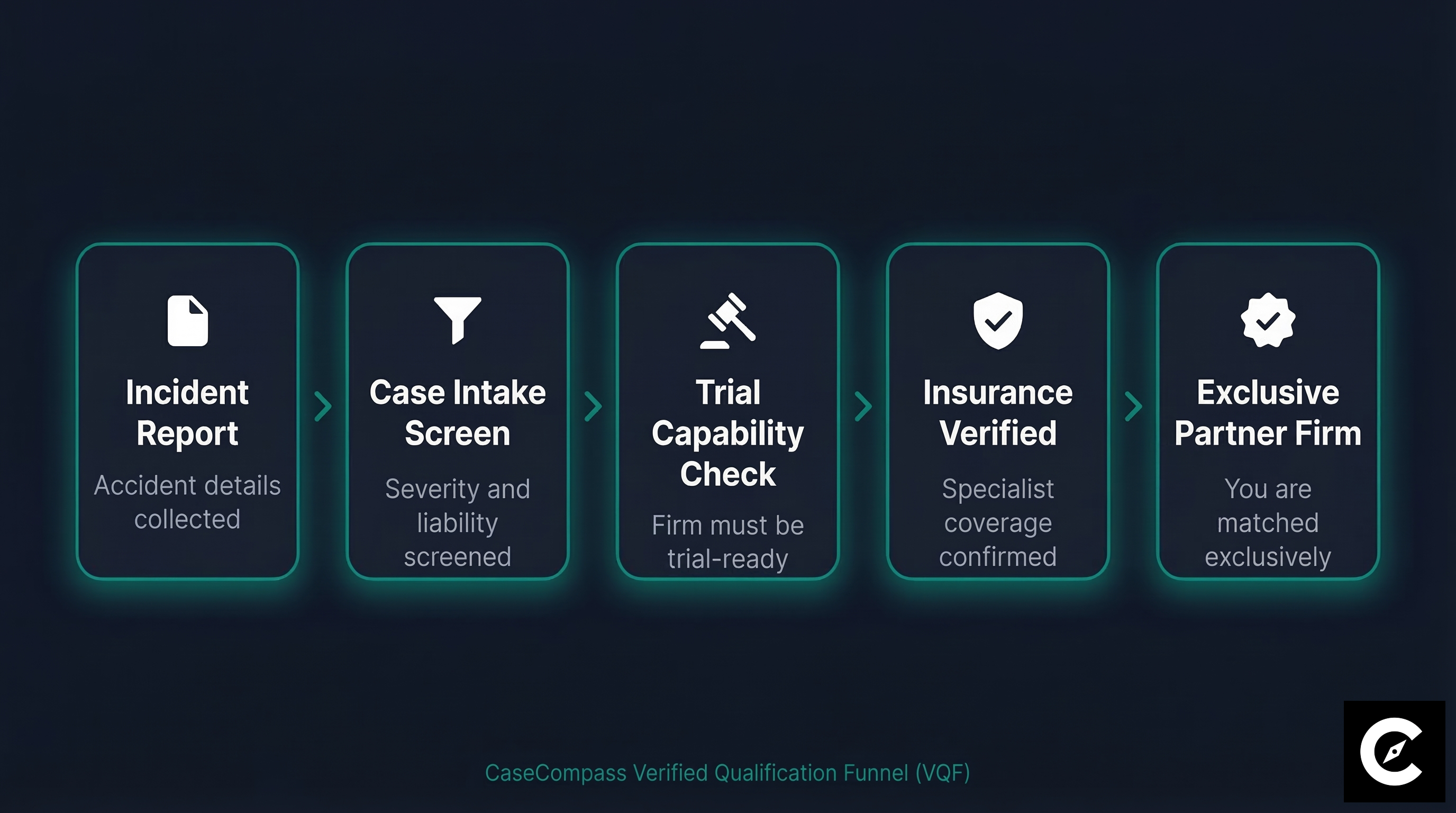
How We Match You with a Verified Firm
Not all law firms are qualified to handle serious injury cases. As shown in our qualification pipeline below, CaseCompass strictly filters incoming cases to ensure you are connected exclusively with a highly-vetted, specialized verified partner firm capable of taking your case to trial if an insurance company refuses to settle fairly.
How much is your case worth in New York?
Statewide settlement data by injury type, verified by David H. Perecman, J.D..
| Metric | Value | Source |
|---|---|---|
| FMCSA minimum liability — general freight | $750,000 | [49 CFR § 387.9](https://www.ecfr.gov/current/title-49/part-387) |
| FMCSA minimum liability — hazmat | $1,000,000 – $5,000,000 | [49 CFR § 387.9](https://www.ecfr.gov/current/title-49/part-387) |
| NY no-fault PIP limit | $50,000 per person | [NY Insurance Law § 5102](https://www.nysenate.gov/legislation/laws/ISC/5102) |
| EDR data preservation window | ~30 days before overwrite | FMCSA ELD compliance standards |
| NY statute of limitations | 3 years (CPLR § 214) | [CPLR § 214](https://www.nysenate.gov/legislation/laws/CVP/214) |
Common Mistakes to Avoid
- 1
Mistake #1: Waiting to contact an attorney
letting EDR data expire. Black box and ELD data is the most powerful evidence in a truck accident case. It proves speed, braking, hours-of-service violations, and GPS position. It is routinely overwritten within 30 days. Every day of delay reduces the evidence available to your case.
- 2
Mistake #2: Settling with the truck's insurer before medical prognosis is complete. Truck accident injuries
spinal cord damage, traumatic brain injury, multiple fractures — often have long recovery timelines. Trucking company insurers are trained to close files quickly. Do not sign any release without a complete medical prognosis and an attorney's review.
- 3
Mistake #3: Only suing the driver, not the company. Under respondeat superior, the trucking company is liable for its driver's negligence if the driver was acting within the scope of employment. The freight broker and cargo loader may also carry separate liability. An experienced attorney identifies all defendants.
Why Work With a CaseCompass Attorney
No upfront cost. No obligation. Just answers.
Your Consultation Is Always Free
Every attorney on CaseCompass works on contingency — you pay nothing upfront, and nothing at all unless your attorney wins or settles your case.
Government-Sourced, Attorney-Verified
Every guide is built from official state records, federal statutes, and government data — then reviewed by a licensed California attorney with a verified clean disciplinary record.
Re-Verified Every 90 Days
Content is reviewed on a 90-day cycle with the reviewing attorney's name and Bar number listed transparently on every page.
24/7 Intake — English & Spanish
Every CaseCompass partner firm provides round-the-clock intake in both English and Spanish so you can get answers the moment you need them.
Your Privacy Is Protected
We never share your personal information without your explicit consent — your eligibility check is free, confidential, and carries zero obligation.
More Help
How to Choose the Right Lawyer
OCA registration verification, consultation questions, red flags, and contingency fee structures under 22 NYCRR § 691.20 and § 603.7.
How to Get Your Accident Report
Step-by-step guide to requesting your New York crash report from GSP or the GSCCCA crash portal.
Find a Trusted Auto Body Shop
Vetted collision repair shops in New York City — insurance-approved and independently rated.
Lowball Settlement Offers
How to detect and counter a lowball insurance offer after your accident in New York.
Insurance Claim Denied?
Steps to take when your insurer denies or undervalues your claim — including NY Insurance Law § 5106 bad faith.
Frequently Asked Questions
Can I sue the trucking company directly for a NYC truck accident?▼
Yes. Under respondeat superior doctrine, the trucking company is liable for its employee-driver's negligence during the course of employment. Additionally, the company may be independently liable for negligent hiring, training, maintenance, or dispatch. Both the driver and the company should typically be named as defendants.
What is an ELD and why does it matter in my NYC truck accident case?▼
An Electronic Logging Device (ELD) records a commercial driver's hours of service, speed, braking events, and GPS position in real time. FMCSA requires all interstate commercial carriers to use ELDs. In a truck accident case, ELD data can prove that a driver exceeded hours-of-service limits — a powerful negligence argument — or establish the truck's exact speed at the moment of impact.
Does no-fault apply to truck accidents in NYC?▼
Yes. New York's no-fault system applies to all motor vehicle accidents, including commercial truck accidents. Your own insurer pays your initial medical bills and lost wages up to $50,000. To recover pain and suffering damages from the truck driver and company, your injuries must meet the serious injury threshold under Insurance Law § 5102(d).
Sources & Citations
- [1] 49 CFR § 387 — FMCSA Financial Responsibility Requirements ↗
- [2] 49 CFR § 395 — FMCSA Hours-of-Service of Drivers ↗
- [3] 49 CFR § 393 — Parts and Accessories Necessary for Safe Operation ↗
- [4] NY Insurance Law § 5102 — Serious Injury Threshold ↗
- [5] NY Vehicle and Traffic Law § 388 — Permissive Use Liability ↗
- [6] FMCSA SAFER Database — Carrier Safety Records ↗
- [7] FMCSA Pre-Employment Screening Program (PSP) ↗
Check My Case Value & Protect My Claim →
Free · No obligation · 24/7 intake open
⚡ Free · No Obligation
See If You Qualify in 60 Seconds
Step 1 — Select accident type
What type of accident were you in?