


Quick AnswerKey TakeawaysWhy Your Own Insur…The UM Arbitration…The Recorded State…What We Do the Mom…FAQsSources

Accidentes de fuga en Los Ángeles (Artículo del abogado)

Explicación práctica de accidentes con fuga en Los Angeles, con enfoque en cobertura UM/UIM y evidencia útil para el caso.

Our Legal Team — Los Angeles Hit-and-Run Accident Lawyers

Our Legal Team — Los Angeles Hit-and-Run Accident Lawyers

Contributing Writer

Yosi Yahoudai, J.D.

Yosi Yahoudai, J.D.

Legal Reviewer · CA Bar #250679 ·

Mar 2026 · 7 min read

Zero Up Front. Always.4.8 · 544 Google reviews

CaseCompass.ai es un recurso legal y servicio de conexion gratuito, no un despacho de abogados. El contenido es solo informativo y no constituye asesoria legal.

Fuente original: Our Legal Team — Los Angeles Hit-and-Run Accident Lawyers

💡 Respuesta rapida

Si el conductor huyó, reporta el choque de inmediato y abre tu reclamo UM/UIM; en California todavía puedes buscar compensación aunque nunca identifiquen al responsable.

Find out if you have a case in Los Angeles

⚡ Free · No Obligation

See If You Qualify in 60 Seconds

Step 1 — Select accident type

What type of accident were you in?
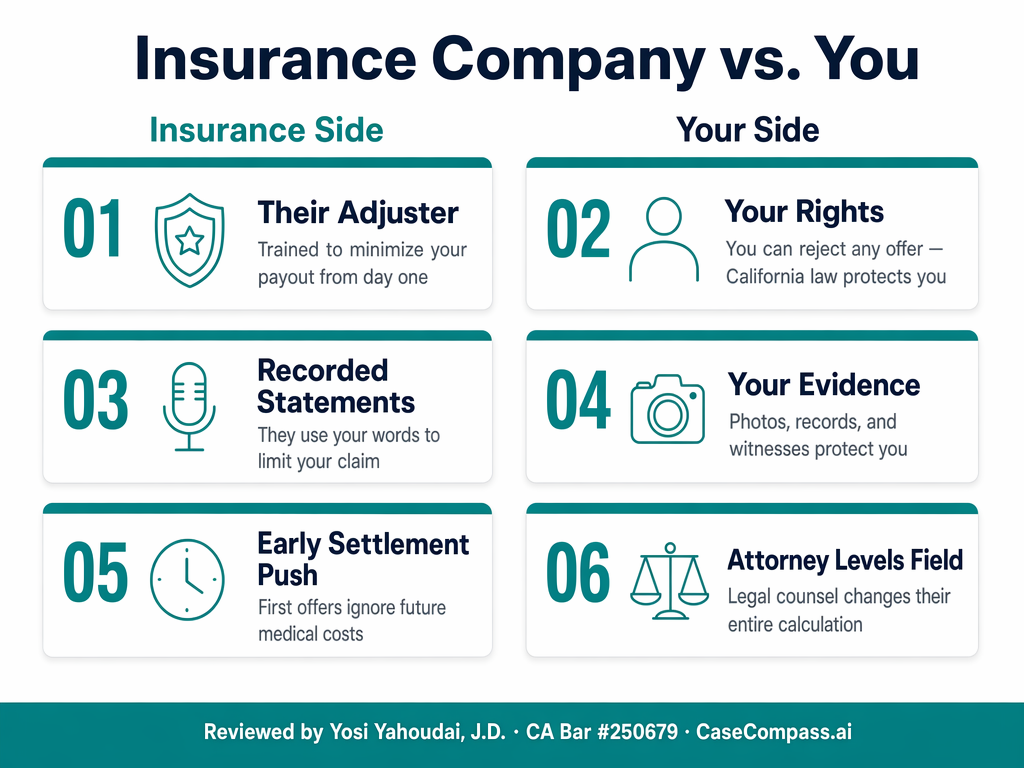
Insurance Company vs. You — what adjusters bring versus what accident victims face, and how a CaseCompass-vetted attorney levels the playing field in California.
Insurance Company vs. You · Reviewed by Yosi Yahoudai, J.D., CA Bar #250679 · CaseCompass.ai

Puntos clave

  • 1.El reporte policial temprano es clave para UM/UIM.
  • 2.Tu propia aseguradora negocia como parte opuesta del reclamo.
  • 3.La documentación médica continua define el valor del caso.

1. Why Your Own Insurer Is Not Your Ally in a UM Claim

Most victims who call us after a hit-and-run believe they have no case because the driver is gone. That belief — which the insurance industry does nothing to correct — is wrong and costly. In California, your own auto policy is often the primary recovery route under Uninsured Motorist coverage mandated by Insurance Code § 11580.2. But here is what nobody tells you: in a UM claim, your own insurer is the adverse party. They send an adjuster, review your statement, and evaluate your claim from the same adversarial position as an at-fault driver's insurer would. We have seen hit-and-run victims lose 40% to 60% of their claim value by treating their own insurer as an advocate during the investigation. They are not. An attorney levels that relationship from day one.

2. The UM Arbitration Right Most Victims Never Use

The most dangerous myth about UM coverage: 'my insurer will take care of me.' They will process the claim. They will not fight for you. In practice, UM settlements are negotiated exactly like third-party claims — your insurer makes an offer based on their claims formula, not what your injuries are actually worth. What most victims do not know: UM claims are subject to binding arbitration in California when the insurer disputes the amount. We call this the UM Arbitration Window — if you accept a settlement without knowing arbitration is available, you permanently waive the right to a neutral decision-maker. We use that arbitration option as leverage in every negotiation to force fair settlements on cases the insurer would otherwise lowball.

3. The Recorded Statement Mistake That Kills Claims

The single most destructive pattern we see in hit-and-run cases is a victim giving their own insurer a recorded statement within 24 to 72 hours of the accident. Your policy requires 'prompt cooperation.' It does not require a recorded statement before you have legal counsel. Insurers use this window to lock in descriptions of 'minor' pain and 'manageable' symptoms — all of which become ammunition to dispute injury value later. The most heartbreaking case we handled was a pedestrian hit-and-run with a traumatic brain injury who described her headache as 'mild' in a same-day recorded statement. The insurer used that single word to dispute $85,000 in neurology bills for 18 months. Wait for counsel before making any statement.

4. What We Do the Moment You Retain Us

When you retain us after a hit-and-run, our first call is not to the insurer — it is to LAPD's traffic division for the incident report and any active BOLO on the vehicle. Our second action is a traffic camera subpoena letter to LADOT, LAPD, and any private businesses at the intersection. Most LA intersections are covered by at least two traffic cameras, and private security footage is typically overwritten within 30 to 72 hours. We have identified hit-and-run drivers on footage the victim never knew existed. If the driver is found, we run parallel tracks: the UM claim and a direct civil suit with punitive damages under California Civil Code § 3294. If they are never found, we take the UM claim to arbitration if the insurer undervalues it.

Not sure if your offer is fair?

Answer 3 questions to see what your case may be worth — free, no obligation.

Start Free Case Review →

Preguntas frecuentes

Can I get compensation if the hit-and-run driver is never found in California?

Yes. California's mandatory UM coverage (Insurance Code § 11580.2) explicitly covers accidents caused by unknown or unidentified drivers. As long as you have a police report and UM coverage on your policy, you can file a claim and recover compensation for medical bills, lost wages, and pain and suffering — regardless of whether the driver is ever identified.

What is uninsured motorist coverage and do I have it in California?

Uninsured motorist (UM) coverage pays for injuries when the at-fault driver has no insurance or flees. California requires every insurer to offer it under Insurance Code § 11580.2. It is included by default unless you signed a written waiver. Check your declarations page to confirm your current UM limits.

What should I do if I witnessed the hit-and-run but the victim did not?

Contact the LAPD non-emergency line and provide your witness account. You can also contact the victim's attorney directly — your statement about the vehicle description, direction of travel, and driver appearance can be critical evidence in the UM claim and any subsequent criminal investigation. California has witness protection provisions for hit-and-run cases.

How long do I have to file a hit-and-run insurance claim in California?

Notify your insurer within 24–72 hours under your policy terms. The civil lawsuit deadline is 2 years from the accident date under CCP § 335.1. If the driver is identified later, you have 2 years from identification to sue directly. Contact an attorney within the first week to protect both tracks.

Will my insurance rates go up if I file a UM claim in California?

California Proposition 103 restricts insurers from raising rates on not-at-fault drivers. Filing a UM claim after a hit-and-run should not result in a premium increase. Confirm this with your insurer before filing, but do not let that concern prevent you from claiming the compensation you are entitled to.

Fuentes y citas

  1. California UM/UIM — [Insurance Code § 11580.2](https://leginfo.legislature.ca.gov/faces/codes_displaySection.xhtml?sectionNum=11580.2.&lawCode=INS)
  2. California Hit-and-Run Law — Vehicle Code § 20001
  3. California [CCP § 335.1](https://leginfo.legislature.ca.gov/faces/codes_displaySection.xhtml?sectionNum=335.1.&lawCode=CCP) — Statute of Limitations
  4. HCUP — Emergency Department Cost Data

Ready to find out if you qualify?

⚡ Free · No Obligation

See If You Qualify in 60 Seconds

Step 1 — Select accident type

What type of accident were you in?

Free Case Review — 60s$0 fee · No obligation