


Accidents move fast. This guide doesn't. Every step below is attorney-reviewed and specific to New York City, New York law — so you don't miss what matters.
Choosing the right car accident attorney in New York City starts with verification, not advertising.
- Verify licensure first: Look up any attorney on the NY Unified Court System Attorney Search before signing anything
- Contingency fee standard: One-third (33⅓%) of net recovery is the typical NYC PI fee, with an optional Appellate Division sliding scale under 22 NYCRR § 691.20. The retainer must be in writing and filed with the Office of Court Administration
- Solicitation of accident victims is illegal: Under NY Judiciary Law § 479, any non-attorney who solicits retainers — at the scene, hospital, or tow yard — commits a Class A misdemeanor. Attorneys who employ such solicitors violate § 482 and face discipline
- Ask who handles your file day-to-day: NYC's largest PI firms run high-volume intake operations — the attorney you meet may not be the attorney who works your case
- Trial experience matters: New York's Insurance Law § 5102(d) serious-injury threshold is litigated constantly. An attorney who has never tried a threshold case has no leverage when an insurer denies it
CaseCompass vets every network attorney against NY OCA registration, disciplinary history, trial experience, and client review volume before referring any case.
Use the quiz below to get matched with a verified NYC attorney — no obligation, 60 seconds.
Check My Case Value & Protect My Claim →
Free · No obligation · 24/7 intake open
⚡ Free · No Obligation
See If You Qualify in 60 Seconds
Step 1 — Select accident type
What type of accident were you in?
Your How to Choose a Car Accident Lawyer
Tap each step as you complete it — your progress saves automatically.
New York State has more than 185,000 registered attorneys — the second-largest bar in the United States — and the heaviest concentration practices in the five boroughs. Choosing the right car accident lawyer in New York City requires knowing what to verify, what to ask, and which red flags signal a firm to avoid.
Why This Matters — And What Insurers Won't Tell You
**Advertising spend is not a quality signal.** New York City is the most saturated personal injury legal market on the East Coast. Subway, taxi, bus, and digital ad spend by NYC PI firms runs into the hundreds of millions annually — and that spend bears no relationship to trial results, attorney-to-client ratios, or case handling quality.
**Written, OCA-filed retainers are required by court rule.** Under 22 NYCRR Part 1215, every NY attorney must provide a written letter of engagement. Under 22 NYCRR § 691.20 (2nd Dept. — Brooklyn, Queens, Staten Island, Long Island) and § 603.7 (1st Dept. — Manhattan, the Bronx), every contingency fee retainer in a PI case must be filed with the Office of Court Administration within 30 days. An attorney who asks you to trust them on fees without a signed written agreement is violating state rule.
**Runner referrals are prosecuted, not just frowned on.** Solicitation by 'runners' is a real and active enforcement issue in NYC. The NY Attorney Grievance Committees and the Manhattan DA's office have brought cases against rings that solicit recent crash victims at hospitals and body shops — and the attorneys who accept those referrals lose their licenses.
New York State has over 185,000 registered attorneys — second-largest bar in the US — with the heaviest concentration in the five boroughs of New York City.
The size of the NYC legal market creates both opportunity and confusion for accident victims. Advertising spend bears no relationship to attorney quality, trial experience, or case outcomes — particularly on contested § 5102(d) serious-injury threshold cases.
Source: New York State Office of Court Administration — Attorney Registration data (nycourts.gov), 2024
Verified Track Record
How The Perecman Firm meets the criteria above — a verified track record (not marketing claims)
Active NY registration, no public discipline
David H. Perecman, NY Bar #1453588 — registered and in good standing; no censure, suspension, or disbarment on record (verified 2026-04-30 via NYS Open Data registry, dataset eqw2-r5nb)
Verify →Trial verdicts on serious-injury motor vehicle cases
$25M motor vehicle / spinal injury verdict, NY County Supreme Court — direct verdict, not settlement
Verify →Multi-million-dollar PI litigation track record
$900M+ recovered across the firm's history; additional $40M construction-accident verdict (2019, NY County) and $15M pedestrian-struck settlement
Verify →§ 5102(d) serious-injury threshold experience
Settlement floor of $100K+ on threshold-qualifying cases — firm policy reflects sustained threshold-motion docket against major NY auto insurers
Verify →Founder-led, direct attorney handling (no intake-handoff)
David H. Perecman personally retains client contact through case resolution; firm founded 1979 — 40+ years of continuous founder leadership
Verify →Bar leadership and industry recognition
NYSTLA (NY State Trial Lawyers Association) Past President; frequent CLE lecturer on labor law and motor vehicle litigation; Best Lawyers in America (PI Litigation – Plaintiffs); Super Lawyers NY Metro Top 100
Verify →
Were you hurt in this type of accident?
Find out if you may be entitled to compensation — it's free and takes 60 seconds.
Check My Eligibility →What To Do Next
- 1
Verify the attorney's registration status before your consultation. Go to the NY Unified Court System Attorney Search and search by name or registration number. Confirm: registered and in good standing, no public discipline (censure, suspension, or disbarment), and admitted to the Appellate Division covering your borough. Any public discipline is a material red flag.
- 2
Ask specifically who will handle your file day-to-day. NYC's high-volume PI firms often have an intake attorney who signs clients and immediately hands files to junior associates or non-attorney case managers. Ask for the name and registration number of the attorney who will personally work your case, and confirm their direct contact information before you sign.
- 3
Get the contingency fee retainer in writing — and confirm it will be filed with OCA. 22 NYCRR § 691.20 (2nd Dept.) and § 603.7 (1st Dept.) require every PI contingency retainer to be filed with the Office of Court Administration within 30 days. The agreement must state the percentage, how case expenses are deducted (before or after fees), and provide the Part 1215 letter of engagement. Do not retain any attorney who cannot produce a signed retainer at retention.
- 4
Ask about trial experience directly: 'How many personal injury cases have you taken to verdict in the last 5 years, and what were the outcomes — particularly on contested § 5102(d) serious-injury threshold cases?' An attorney who settles every case has no credible threat of trial. NYC insurers track which plaintiff's firms try threshold cases and which always fold, and they price offers accordingly.
- 5
Check review volume and recency on Google, Avvo, and the NY Attorney Grievance Committee public discipline database. Focus on reviews from the past 24 months — high-volume NYC firms with outdated reviews may have changed ownership, lost key attorneys, or declined in quality. Look specifically for reviews mentioning attorney communication, timeline transparency, and settlement satisfaction.
- 6
If someone approached you at the accident scene, an emergency room, a tow yard, or a body shop and offered to refer you to an attorney, do not use that referral. Under NY Judiciary Law § 479, that solicitation is a Class A misdemeanor, and the attorney who accepts the referral violates § 482 and faces discipline up to disbarment. A case built on illegal solicitation can be compromised. Report the contact to the appropriate Attorney Grievance Committee at nycourts.gov/attorneys/grievance.
How We Match You with a Verified Firm
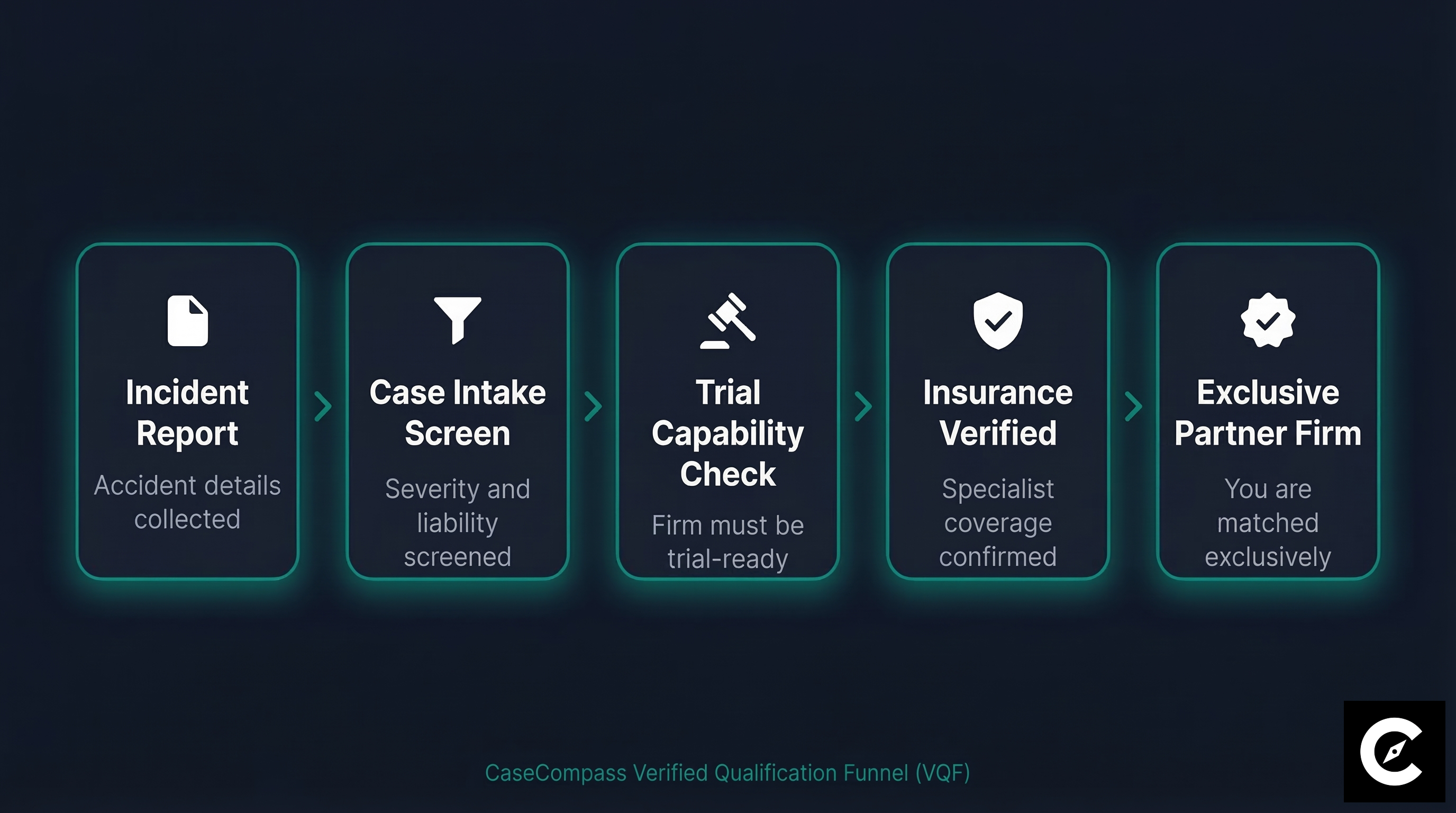
Not all law firms are qualified to handle serious injury cases. As shown in our qualification pipeline below, CaseCompass strictly filters incoming cases to ensure you are connected exclusively with a highly-vetted, specialized verified partner firm capable of taking your case to trial if an insurance company refuses to settle fairly.
How much is your case worth in New York?
Statewide settlement data by injury type, verified by David H. Perecman, J.D..
| Metric | Value | Source |
|---|---|---|
| NY contingency fee — typical NYC PI standard | 33⅓% of net recovery (after expenses) | [22 NYCRR § 691.20](https://www.law.cornell.edu/regulations/new-york/22-NYCRR-691.20) (2nd Dept.) and [§ 603.7](https://www.law.cornell.edu/regulations/new-york/22-NYCRR-603.7) (1st Dept.) — Appellate Division rules |
| NY Appellate Division optional sliding scale (alternative to one-third) | 50% to $1k, 40% next $2k, 35% next $22k, 25% above $25k | [22 NYCRR § 691.20(e)(2)](https://www.law.cornell.edu/regulations/new-york/22-NYCRR-691.20) |
| NY medical malpractice — mandatory sliding scale (different from PI) | 30% first $250k → 10% above $1.25M | [NY Judiciary Law § 474-a](https://www.nysenate.gov/legislation/laws/JUD/474-A) |
| Runner / solicitation penalty | Class A misdemeanor — up to 1 year jail + fine | [NY Judiciary Law § 479](https://www.nysenate.gov/legislation/laws/JUD/479) and [§ 482](https://www.nysenate.gov/legislation/laws/JUD/482) |
| NY OCA registered attorneys (statewide) | 185,000+ | NY Office of Court Administration — Attorney Registration data (nycourts.gov), 2024 |
| Attorney-represented cases — net settlement advantage | 3–4× more net of fees | Insurance Research Council — Auto Injury Study (insurance-research.org), 2023 |
| NYC Supreme Court — PI trial timeline | 2–4 years from filing to verdict | NY State Unified Court System — Civil Supreme caseload statistics (nycourts.gov), 2024 |
| Free consultation — NYC PI firm standard | Standard at virtually all NYC PI firms — no upfront cost | NY Rules of Professional Conduct — Attorney Advertising (nycourts.gov) |
Common Mistakes to Avoid
- 1
Choosing an attorney based on subway, TV, or billboard advertising
NYC PI advertising spend is among the highest in any legal market in the country. The firms with the most aggressive subway and digital ad presence often run the highest case volumes and the most limited attorney-per-client contact. A heavily advertised firm may assign your case to a non-attorney case manager and push for a quick settlement to maximize throughput. Evaluate based on trial record, OCA registration history, and specific attorney experience — not creative budget.
- 2
Signing a retainer without reading the cost deduction structure
Under 22 NYCRR § 691.20 and § 603.7, the retainer must state whether litigation costs (filing fees, expert fees, deposition costs, IME defense) are deducted from gross before the attorney's percentage is calculated, or from your net share after. The difference can be tens of thousands of dollars on a serious-injury case. 'Costs deducted from gross first' maximizes your net; 'costs from your share' reduces it. Confirm this before signing.
- 3
Retaining an attorney through a runner referral
If anyone approached you at the scene, hospital, body shop, or tow yard and offered a referral, do not use it. Under NY Judiciary Law § 479, that person committed a Class A misdemeanor, and the attorney who accepts the referral violates § 482 and faces discipline. A case built on illegal solicitation can be compromised if the Attorney Grievance Committee investigates. Find your own attorney through the NY Unified Court System search, CaseCompass, or a verified bar referral service.
- 4
Failing to ask about § 5102(d) threshold trial experience
New York's serious-injury threshold under Insurance Law § 5102(d) is the most heavily litigated issue in NY auto cases. Insurers routinely move for summary judgment on threshold to defeat tort recovery. An attorney who has never defeated a threshold motion or tried a threshold case to verdict has no credible leverage. Ask: 'How many threshold motions have you defended in the past 3 years? What are your win rates? How many threshold cases have you tried to verdict?'
- 5
Not verifying who actually handles the file
The attorney you meet at consultation in a NYC high-volume firm may be an intake attorney whose primary role is to sign clients, not work cases. Your file may be transferred to a junior associate with 1–2 years of experience or a paralegal. Ask: 'Who specifically will be my day-to-day attorney contact? Can I meet them before signing the retainer?' If the firm cannot confirm, it is a warning sign.
- 6
Choosing a general practice attorney for a NY PI case
General practitioners who occasionally handle PI matters lack the medical expert relationships, no-fault arbitration experience, and IME-defense infrastructure that specialist NYC PI firms maintain. NY no-fault practice is its own subspecialty under Insurance Law Article 51 — and § 5102(d) threshold litigation requires sustained docket experience. A specialty firm with established medical lien networks and dedicated threshold motion practice consistently outperforms generalists handling NY PI cases intermittently.
Why Work With a CaseCompass Attorney
No upfront cost. No obligation. Just answers.
Your Consultation Is Always Free
Every attorney on CaseCompass works on contingency — you pay nothing upfront, and nothing at all unless your attorney wins or settles your case.
Government-Sourced, Attorney-Verified
Every guide is built from official state records, federal statutes, and government data — then reviewed by a licensed California attorney with a verified clean disciplinary record.
Re-Verified Every 90 Days
Content is reviewed on a 90-day cycle with the reviewing attorney's name and Bar number listed transparently on every page.
24/7 Intake — English & Spanish
Every CaseCompass partner firm provides round-the-clock intake in both English and Spanish so you can get answers the moment you need them.
Your Privacy Is Protected
We never share your personal information without your explicit consent — your eligibility check is free, confidential, and carries zero obligation.
More Help
How to Get Your Accident Report
Step-by-step guide to requesting your New York crash report from GSP or the GSCCCA crash portal.
Find a Trusted Auto Body Shop
Vetted collision repair shops in New York City — insurance-approved and independently rated.
Lowball Settlement Offers
How to detect and counter a lowball insurance offer after your accident in New York.
Insurance Claim Denied?
Steps to take when your insurer denies or undervalues your claim — including NY Insurance Law § 5106 bad faith.
Frequently Asked Questions
How do I verify if a car accident attorney is registered in New York?▼
Search by name or registration number at the NY Unified Court System Attorney Search. Verify: registered and in good standing, no public discipline (censure, suspension, or disbarment), and admitted in the Appellate Division covering your borough (1st Dept. for Manhattan/Bronx; 2nd Dept. for Brooklyn/Queens/Staten Island). Do this before your consultation — not after you have signed anything. If the attorney cannot provide their registration number immediately, that alone is a red flag.
What is a contingency fee and what percentage is normal for a car accident case in New York City?▼
A contingency fee means the attorney receives a percentage of your recovery — and nothing if you recover nothing. The typical NYC PI standard is one-third (33⅓%) of the net recovery after expenses are deducted from the gross. NY Appellate Divisions also permit an optional sliding scale under 22 NYCRR § 691.20 (2nd Dept.) and § 603.7 (1st Dept.). Either way, the retainer must be in writing and filed with the Office of Court Administration within 30 days. Always confirm whether litigation costs come out of the gross before fees or from your share. Note: medical malpractice cases follow a different mandatory sliding scale under Judiciary Law § 474-a.
What is a 'runner' in a New York personal injury case?▼
A runner is a person who solicits accident victims — at crash scenes, hospitals, tow yards, body shops, or medical offices — and directs them to a specific attorney in exchange for a referral fee. This is a Class A misdemeanor under NY Judiciary Law § 479, punishable by up to one year in jail. Attorneys who accept runner referrals violate § 482 and the NY Rules of Professional Conduct, and face discipline up to disbarment. If you were contacted this way, do not use that referral — report it to the Attorney Grievance Committee for your borough.
What questions should I ask a car accident attorney during a free consultation?▼
Ask: (1) Who specifically will handle my file day-to-day, and what is their NY registration number? (2) How many car accident cases did you take to verdict in the past 3 years and what were the outcomes? (3) How do you handle § 5102(d) serious-injury threshold motions and what is your win rate? (4) What is your contingency fee, and are case expenses deducted before or after your percentage? (5) How often do you communicate case updates and through what channel? Any attorney who cannot answer these directly and specifically is not the right fit.
Does hiring a lawyer really increase my settlement after the fee?▼
Yes. The Insurance Research Council's 2023 Auto Injury Study found that represented accident victims receive settlements 3–4 times higher than unrepresented victims — net of attorney fees. The contingency fee (33⅓%) is more than offset by the increase in gross settlement. This is consistent across injury levels, and especially pronounced in NY where § 5102(d) serious-injury threshold disputes determine whether the case can recover pain-and-suffering damages at all. There is no financial risk in a free consultation, and the fee is paid only from your recovery.
How does CaseCompass vet the attorneys in its network?▼
Every attorney in the CaseCompass network is verified against: (1) active NY Office of Court Administration registration with no public discipline history; (2) confirmed personal injury practice area and New York City case experience; (3) Google review volume of 200+ at 4.8 stars or higher; (4) no prior runner / solicitation complaints or grievance investigations; and (5) direct attorney-to-client file handling — no non-attorney case manager assignments. CaseCompass re-reviews network attorneys quarterly.
What is the difference between a settlement attorney and a trial attorney in a NY PI case?▼
A settlement attorney resolves all cases before trial — typically faster, but with lower settlement values because the insurer faces no trial risk. A trial attorney is prepared and willing to take cases to verdict, creating credible leverage in every negotiation. In NY Supreme Court (which handles civil cases above $25,000), PI cases can take 2–4 years to reach trial — but the threat of trial consistently produces higher pre-trial settlements from insurers who know the plaintiff's firm actually tries cases. This is especially important when the defense is moving for summary judgment on the § 5102(d) threshold.
Can I switch attorneys in the middle of a New York personal injury case?▼
Yes. New York law allows you to discharge any attorney at any time. The original attorney retains a charging lien on the file for the reasonable value of their work under quantum meruit — they are paid from the final settlement based on contribution, not a full contingency. If you are dissatisfied with your attorney's communication, responsiveness, or strategy, switching is a right protected under NY Rules of Professional Conduct 1.16. Contact a new attorney first — they will handle the lien resolution and substitution of counsel.
What red flags should I watch for when hiring a car accident lawyer in NYC?▼
Red flags include: (1) attorney cannot immediately provide their NY registration number; (2) you were referred by someone who approached you at the scene, hospital, body shop, or tow yard; (3) the retainer is verbal rather than written and filed with OCA; (4) the firm cannot confirm who will specifically work your file; (5) the attorney cannot cite any verdicts, threshold motion wins, or trial experience; (6) you are pressured to sign on the same day as the consultation without time to review; (7) the firm advertises 'guaranteed results' — which violates NY Rules of Professional Conduct 7.1.
Does borough or office location matter when choosing a car accident lawyer in NYC?▼
Less than most people think. Most car accident cases resolve through negotiation, not courtroom appearances — and an attorney's quality and relationships matter more than office location. That said, an attorney admitted in the Appellate Division covering your borough (1st Dept. for Manhattan/Bronx; 2nd Dept. for Brooklyn/Queens/Staten Island), with experience in the relevant Supreme Court county clerk's docket, NYPD MV-104A report protocols, and established relationships with NYC-based medical experts and accident reconstruction specialists has practical advantages over an out-of-county practitioner handling an NYC case intermittently.
Sources & Citations
- [1] 22 NYCRR § 691.20 — Contingency Fee Schedule (2nd Dept.: Brooklyn, Queens, Staten Island) ↗
- [2] 22 NYCRR § 603.7 — Contingency Fee Schedule (1st Dept.: Manhattan, Bronx) ↗
- [3] 22 NYCRR Part 1215 — Written Letter of Engagement Requirement ↗
- [4] NY Judiciary Law § 479 — Solicitation of Retainers Prohibited ↗
- [5] NY Judiciary Law § 482 — Employment of Solicitors Prohibited ↗
- [6] NY Judiciary Law § 474-a — Medical Malpractice Contingency Fee Schedule ↗
- [7] NY Insurance Law § 5102(d) — Serious Injury Threshold ↗
- [8] NY Unified Court System — Attorney Search ↗
- [9] Insurance Research Council — Auto Injury Study 2023 ↗
Check My Case Value & Protect My Claim →
Free · No obligation · 24/7 intake open
⚡ Free · No Obligation
See If You Qualify in 60 Seconds
Step 1 — Select accident type
What type of accident were you in?