


Accidents move fast. This guide doesn't. Every step below is attorney-reviewed and specific to Dallas, Texas law — so you don't miss what matters.
If you were the victim of a hit-and-run in Dallas, your Uninsured Motorist (UM) coverage is your primary recovery path. Texas gives you 2 years to file a lawsuit under Tex. Civ. Prac. & Rem. Code § 16.003.
Immediate steps after a hit-and-run:
- Call 911 immediately — a police report is essential for UM claims. Note the fleeing vehicle's color, make, model, and any partial plate numbers
- UM/UIM coverage is your primary path when the at-fault driver is unidentified. Texas insurers must offer UM coverage, but you can reject it in writing
- Police report deadline: File within 10 days at any Dallas PD substation if officers did not respond to the scene
- Leaving the scene is a criminal offense under Tex. Transp. Code § 550.021
If you declined UM coverage, your options narrow significantly. Contact a Dallas hit-and-run attorney to identify all available recovery paths.
Quick Answer — Source Index4§ 2 LAW◎ 2 GOVclaim-level sources
Texas Statute of Limitations — Tex. Civ. Prac. & Rem. Code Ch. 16Texas Statute of Limitations✓ Official (source-only)
Texas Hit-and-Run Law — Tex. Transp. Code Ch. 550Texas Hit-and-Run Law✓ Official (source-only)
TxDOT Motor Vehicle Crash Statistics 2024TxDOT Motor Vehicle Crash Statistics 2024✓ Official (source-only)
Texas Department of Insurance — UM/UIM CoverageTexas Department of Insurance✓ Official (source-only)
Check My Case Value & Protect My Claim →
Free · No obligation · 24/7 intake open
⚡ Free · No Obligation
See If You Qualify in 60 Seconds
Step 1 — Select accident type
What type of accident were you in?
Your Hit-and-Run Accident
Tap each step as you complete it — your progress saves automatically.
Hit-and-run crashes are a persistent problem in Dallas County, where 46,257 total crashes were recorded in 2024. When the at-fault driver flees, your Uninsured Motorist coverage becomes the primary — and often only — path to compensation.
Why This Matters — And What Insurers Won't Tell You
Hit-and-run victims face a unique problem: you have injuries and damages, but the person responsible has vanished. In Dallas, police hit-and-run investigations are resource-intensive and many cases remain unsolved — meaning your Uninsured Motorist coverage may be the only compensation source.
Texas insurers must offer UM/UIM coverage under state law, but drivers who rejected it in writing have no first-party coverage to fall back on. Even when UM coverage exists, insurers treat these claims adversarially — they are paying out of their own policy, not another company's.
The insurer's first move is to question whether the hit-and-run actually occurred, whether your injuries are related, and whether you took reasonable steps to identify the fleeing driver. A police report filed within 24 hours, witness statements, and any surveillance footage are critical to defeating these defenses. Without this evidence, even a valid UM claim can be denied or severely undervalued.
Leaving the scene of a crash involving injury is a felony in Texas under Tex. Transp. Code § 550.021, carrying up to 5 years in prison.
Despite criminal penalties, many hit-and-run drivers in Dallas are never identified. UM/UIM coverage is the only reliable recovery mechanism when the at-fault driver flees.
Source: Texas Transportation Code Ch. 550
Were you hurt in this type of accident?
Find out if you may be entitled to compensation — it's free and takes 60 seconds.
Check My Eligibility →What To Do Next
- 1
Call 911 immediately. Note everything you can about the fleeing vehicle: color, make, model, direction of travel, and any partial license plate characters. A police report is essential for any UM/UIM claim.
- 2
Look for witnesses and ask them to stay until police arrive. Witnesses who saw the fleeing vehicle can provide details you missed. Get their names and phone numbers — independent witness statements significantly strengthen UM claims.
- 3
Check for surveillance cameras. Nearby businesses, traffic cameras, and residential doorbell cameras may have captured the hit-and-run. Note camera locations and ask officers to collect footage before it is overwritten.
- 4
Photograph everything: your vehicle damage, any debris left by the fleeing vehicle (paint transfer, broken parts), your injuries, road conditions, and the exact location of the crash.
- 5
Seek medical treatment the same day. Even if injuries seem minor, adrenaline masks symptoms. A same-day medical record links your injuries to the hit-and-run — your UM insurer will scrutinize any treatment gap.
- 6
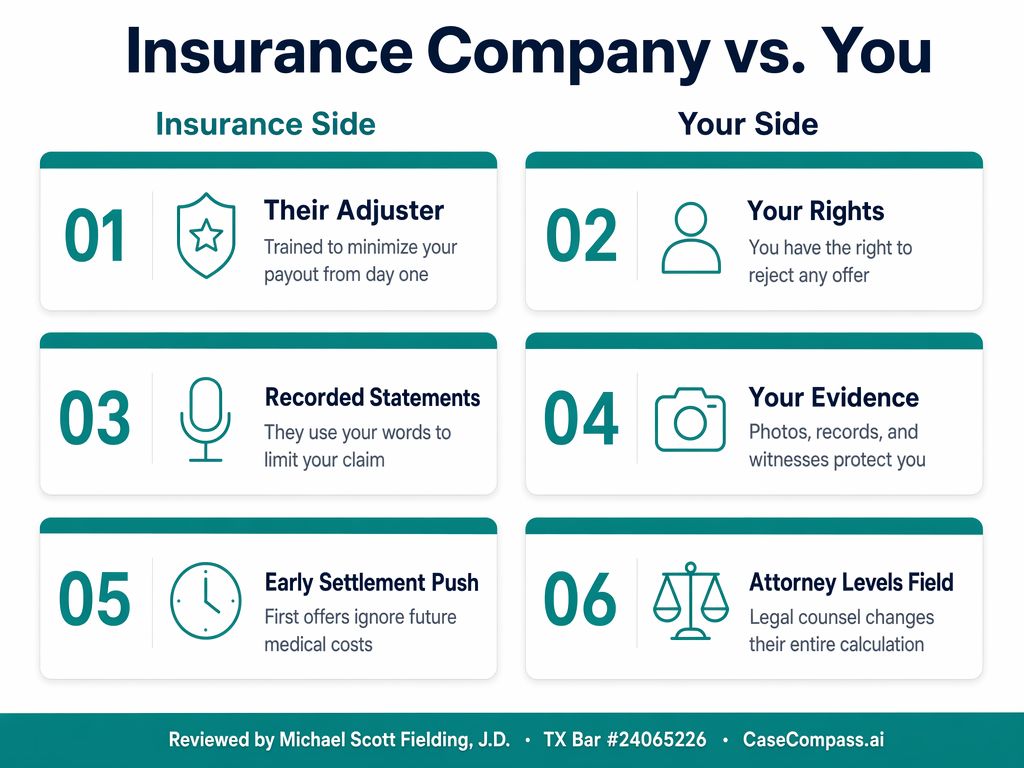
Contact your own insurance company to file a UM claim. Then contact a hit-and-run attorney. Your insurer is an adverse party in UM claims — they pay from their own funds and have incentives to minimize your payout.
Expert Insight from Our Legal Team
Written by Fielding Law · TX Bar #24065226 · Reviewed by Michael Scott Fielding, J.D. · Adapted for CaseCompass
1The Multi-Party Investigation Protocol for Unclear Fault Crashes▼
When the at-fault driver flees, fault is inherently unclear until the driver is identified — if they ever are. In our experience handling Dallas-area hit-and-run cases, the first 72 hours determine whether your case has one defendant or zero. Michael Fielding's team runs a parallel investigation alongside Dallas PD: reviewing traffic camera footage from TxDOT's DFW network, sending preservation letters to businesses within a quarter-mile radius, and cross-referencing paint transfer samples with vehicle databases. The police report is the starting point, not the ending point. In multi-vehicle scenarios on I-35E or I-30, three or four parties may share fault. Missing a potentially liable driver — including the one who fled — means missing an insurance policy.
2Why Insurance Companies Fight UM Claims Harder Than Third-Party Claims▼
When you file against another driver's insurer, that company is defending someone else's money. When you file a UM claim, your own insurer is defending their own funds. The dynamic changes entirely. In unclear-fault hit-and-run cases, your insurer will scrutinize whether the hit-and-run actually occurred, whether your injuries are causally related, and whether you contributed to the crash. We have seen UM claims denied based on a 48-hour gap between the crash and the police report. The insurer argued the gap suggested the damage was pre-existing. A same-day police report, timestamped photos, and a witness statement defeated that defense — but only because the evidence existed.
3Comparative Fault Defense: How Insurers Use the 51% Bar Against Hit-and-Run Victims▼
Texas's 51% bar rule under Tex. Civ. Prac. & Rem. Code § 33.001 gives insurers a powerful tool in hit-and-run cases. When the at-fault driver is unidentified, the insurer can argue that you contributed to the crash — changing lanes unsafely, speeding, or failing to take evasive action — without the other driver present to contradict them. We counter this by reconstructing the crash independently. Accident reconstruction experts analyze skid marks, vehicle damage patterns, and road geometry to establish what happened. Dashcam footage from your vehicle or nearby vehicles provides objective evidence of pre-crash behavior. The goal is to establish that the fleeing driver bore primary fault before the insurer can build a counter-narrative.
How We Match You with a Verified Firm
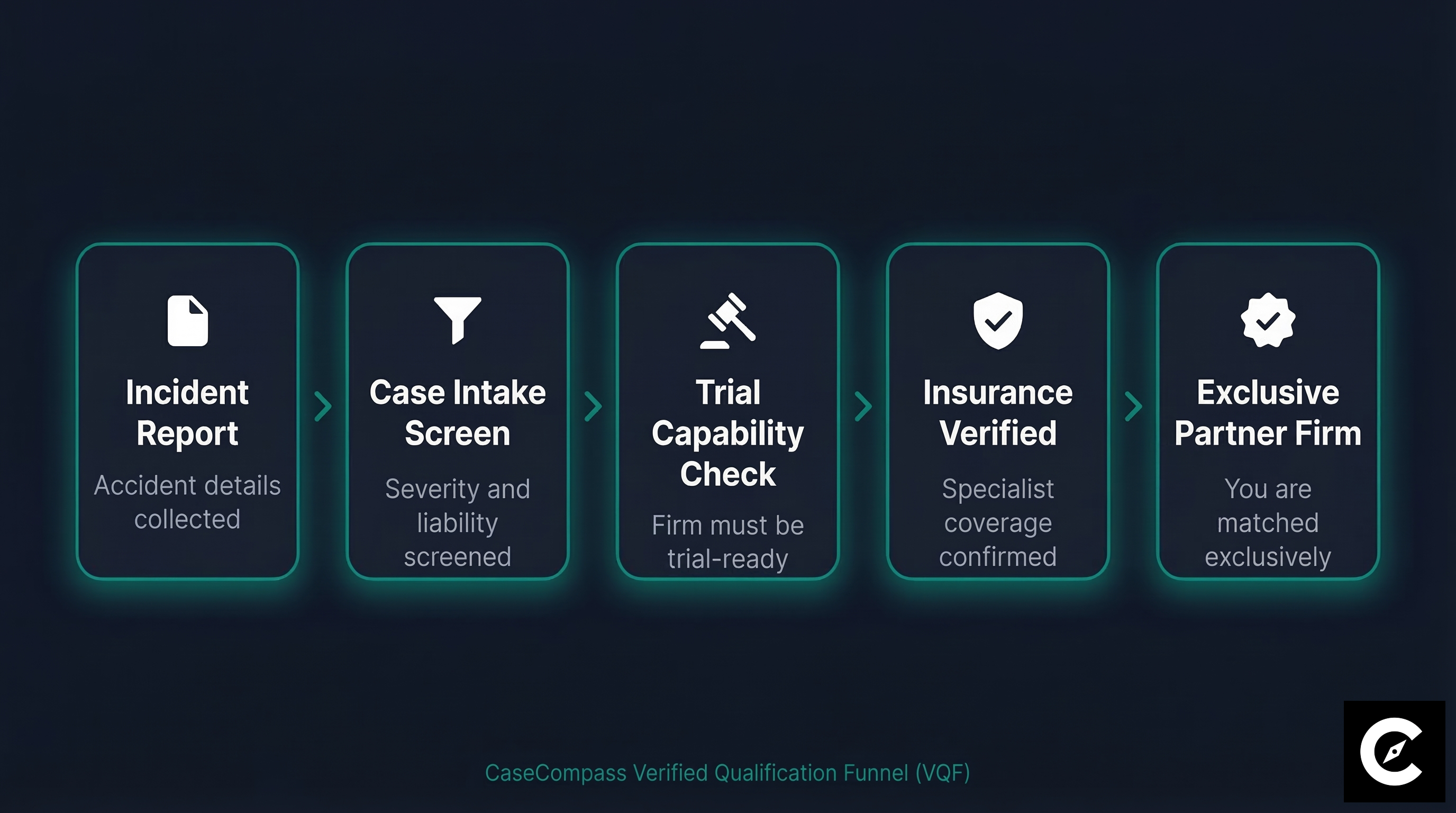
Not all law firms are qualified to handle serious injury cases. As shown in our qualification pipeline below, CaseCompass strictly filters incoming cases to ensure you are connected exclusively with a highly-vetted, specialized verified partner firm capable of taking your case to trial if an insurance company refuses to settle fairly.
How much is your case worth in Texas?
Statewide settlement data by injury type, verified by Michael Scott Fielding, J.D..
| Metric | Value | Source |
|---|---|---|
| Texas statute of limitations — personal injury | 2 years from accident date | [Tex. Civ. Prac. & Rem. Code § 16.003](https://statutes.capitol.texas.gov/Docs/CP/htm/CP.16.htm) |
| Criminal penalty for leaving the scene (injury crash) | Felony — up to 5 years in prison | [Tex. Transp. Code § 550.021](https://statutes.capitol.texas.gov/Docs/TN/htm/TN.550.htm) |
| UM/UIM coverage requirement | Must be offered; can be rejected in writing | [Texas Department of Insurance](https://www.tdi.texas.gov/consumer/auto-insurance.html) |
| Texas minimum liability coverage | $50,000/$100,000/$40,000 | [Tex. Transp. Code § 601.072](https://statutes.capitol.texas.gov/Docs/TN/htm/TN.601.htm) (updated Jan 1, 2026) |
| Modified comparative negligence threshold | 51% — exceed this and you recover nothing | [Tex. Civ. Prac. & Rem. Code § 33.001](https://statutes.capitol.texas.gov/Docs/CP/htm/CP.33.htm) |
Common Mistakes to Avoid
- 1
Mistake #1: Failing to file a police report immediately. A police report is the foundation of every UM hit-and-run claim. Without it, your insurer will question whether the hit-and-run occurred at all. If police don't respond to the scene, you must file a report at a Dallas PD substation within 10 days
but 24 hours is the practical deadline for preserving useful evidence. Call 911 at the scene. File a report the same day.
- 2
Mistake #2: Not checking for surveillance footage within 24 hours. Business security cameras, traffic cameras, and doorbell cameras typically overwrite footage within 24–72 hours. This footage may capture the fleeing vehicle's license plate, make, model, and direction of travel
turning an unsolved hit-and-run into an identified defendant. Canvas the area for cameras immediately and ask your attorney to send preservation requests to nearby businesses.
- 3
Mistake #3: Assuming you have no claim if the driver is never found. If you carry UM coverage, you have a claim against your own insurer regardless of whether the fleeing driver is identified. UM coverage pays for medical expenses, lost wages, and pain and suffering. Many victims don't realize they have this coverage or that it applies to hit-and-run crashes. Check your policy or call your insurer to confirm UM/UIM coverage status.
- 4
Mistake #4: Treating your own insurer as an ally in a UM claim. In a standard car accident claim, you file against the other driver's insurance. In a UM hit-and-run claim, you file against your own insurer
and they become an adverse party. Your insurer pays from their own funds and has financial incentives to minimize your payout. They will scrutinize your medical records, question causation, and push for early settlement. Treat a UM claim like any adversarial negotiation. Retain an attorney before filing.
Why Work With a CaseCompass Attorney
No upfront cost. No obligation. Just answers.
Your Consultation Is Always Free
Every attorney on CaseCompass works on contingency — you pay nothing upfront, and nothing at all unless your attorney wins or settles your case.
Government-Sourced, Attorney-Verified
Every guide is built from official state records, federal statutes, and government data — then reviewed by a licensed California attorney with a verified clean disciplinary record.
Re-Verified Every 90 Days
Content is reviewed on a 90-day cycle with the reviewing attorney's name and Bar number listed transparently on every page.
24/7 Intake — English & Spanish
Every CaseCompass partner firm provides round-the-clock intake in both English and Spanish so you can get answers the moment you need them.
Your Privacy Is Protected
We never share your personal information without your explicit consent — your eligibility check is free, confidential, and carries zero obligation.
More Help
How to Choose the Right Lawyer
Bar verification, consultation questions, red flags, and contingency fee structures under Texas law.
Find a Trusted Auto Body Shop
Vetted collision repair shops in Dallas — insurance-approved and independently rated.
Lowball Settlement Offers
How to detect and counter a lowball insurance offer after your accident.
Insurance Claim Denied?
Steps to take when your insurance company denies or undervalues your claim.
Frequently Asked Questions
What should I do after a hit-and-run in Dallas?▼
Call 911, note everything about the fleeing vehicle (color, make, direction, partial plate), find witnesses, check for surveillance cameras, photograph the scene, and seek medical care the same day. File a police report within 24 hours and contact a hit-and-run attorney to file a UM claim.
What happens if the hit-and-run driver is never found in Texas?▼
Your Uninsured Motorist coverage becomes your primary recovery path. UM coverage pays for medical bills, lost wages, and pain and suffering even when the at-fault driver is unidentified. If you declined UM coverage, your options are limited to suing a John Doe defendant — which requires proving the hit-and-run caused your injuries.
Can I still get compensation if the other driver fled the scene?▼
Yes, through your UM/UIM insurance policy. Texas insurers must offer UM coverage, though drivers can decline it in writing. If you have UM coverage, it applies to hit-and-run crashes where the at-fault driver is unidentified. Contact your insurer and a hit-and-run attorney to file the claim.
Will my insurance cover a hit-and-run in Texas?▼
Your Uninsured Motorist (UM) coverage covers hit-and-run crashes. Your collision coverage may cover vehicle damage but not medical expenses. If you have both UM and collision coverage, you can file separate claims. If you declined UM coverage, only collision applies — and medical costs are your responsibility.
What are the penalties for a hit-and-run in Texas?▼
Leaving the scene of a crash involving injury is a felony under Tex. Transp. Code § 550.021, carrying up to 5 years in prison and fines up to $5,000. If the crash caused death, penalties increase to up to 20 years. Property-damage-only hit-and-runs are misdemeanors.
How long do police investigate a hit-and-run in Dallas?▼
Investigation timelines vary. Dallas PD prioritizes hit-and-run cases involving serious injury or death. Cases with surveillance footage or witness descriptions of the vehicle get more investigative resources. Minor property-damage cases may receive limited follow-up. Filing a detailed police report with all available evidence increases the chance of identification.
Do I have to file a police report for a hit-and-run in Texas?▼
Texas law requires drivers involved in any crash to stop and exchange information. If the other driver fled, you should file a police report to document the hit-and-run. The report is essential for UM insurance claims and any future lawsuit. File at any Dallas PD substation if officers did not respond to the scene.
Can I use my PIP coverage after a hit-and-run in Dallas?▼
Yes. If you carry Personal Injury Protection, PIP pays for medical bills and lost wages regardless of fault — including hit-and-run crashes. PIP provides immediate financial relief while your UM claim is being processed. Texas insurers must offer PIP, though drivers can reject it in writing.
Sources & Citations
Check My Case Value & Protect My Claim →
Free · No obligation · 24/7 intake open
⚡ Free · No Obligation
See If You Qualify in 60 Seconds
Step 1 — Select accident type
What type of accident were you in?