


Accidents move fast. This guide doesn't. Every step below is attorney-reviewed and specific to Dallas, Texas law — so you don't miss what matters.
If you were injured in a motorcycle accident in Dallas, Texas gives you 2 years to file under Tex. Civ. Prac. & Rem. Code § 16.003. Your claim is not eliminated by failure to wear a helmet — but it may be reduced.
Key facts for motorcycle accident victims:
- Helmet law: Texas requires helmets for riders under 21. Riders 21+ may ride without a helmet if they complete a safety course or carry $10,000 in medical coverage under Tex. Transp. Code § 661.003
- 51% fault bar: Texas's modified comparative negligence rule applies. If you are more than 50% at fault, you recover nothing
- Lane splitting: Not legal in Texas. Riding between lanes of traffic can be used against you in fault allocation
- 2024 statewide toll: 585 motorcyclist fatalities — 37% not wearing helmets
Motorcycle injuries are typically severe. Seek emergency care and contact a Dallas motorcycle accident attorney immediately.
Quick Answer — Source Index4§ 3 LAW◎ 1 GOVclaim-level sources
Texas Statute of Limitations — Tex. Civ. Prac. & Rem. Code Ch. 16Texas Statute of Limitations✓ Official (source-only)
Texas Helmet Law — Tex. Transp. Code Ch. 661Texas Helmet Law✓ Official (source-only)
TxDOT Motor Vehicle Crash Statistics 2024TxDOT Motor Vehicle Crash Statistics 2024✓ Official (source-only)
Texas Comparative Fault — Tex. Civ. Prac. & Rem. Code Ch. 33Texas Comparative Fault✓ Official (source-only)
Check My Case Value & Protect My Claim →
Free · No obligation · 24/7 intake open
⚡ Free · No Obligation
See If You Qualify in 60 Seconds
Step 1 — Select accident type
What type of accident were you in?
Your Motorcycle Accident
Tap each step as you complete it — your progress saves automatically.
Texas recorded 585 motorcyclist fatalities statewide in 2024 — with 37% of deceased riders not wearing helmets, according to TxDOT. Dallas County's congested freeways and wide arterials make left-turn collisions and lane-change crashes the most common motorcycle accident scenarios.
Why This Matters — And What Insurers Won't Tell You
Motorcycle riders face a bias that car accident victims do not: adjusters and jurors assume riders were reckless. The first thing an insurer investigates after a motorcycle crash is whether the rider was wearing a helmet, whether they were speeding, and whether they were lane splitting. Each factor is used to inflate your fault percentage toward the 51% bar.
Texas allows riders over 21 to legally ride without a helmet under specific conditions. But 'legally allowed' does not mean 'free from consequences in a claim.' Defense attorneys routinely argue that failure to wear a helmet contributed to head injury severity — even when the crash was entirely the other driver's fault. This is a comparative negligence argument, not a legal violation argument, and it works more often than it should.
Motorcycle injuries are catastrophic by nature. With no vehicle frame, no airbags, and no seatbelt, the rider absorbs the full force of impact. Road rash, compound fractures, spinal cord injuries, and traumatic brain injuries are standard — not exceptional. Treatment costs routinely exceed $100,000, and the long-term disability and lost earning capacity often dwarf the initial medical bills.
Texas recorded 585 motorcyclist fatalities in 2024 — 37% of deceased riders were not wearing helmets.
Dallas County freeways see high-speed motorcycle crashes concentrated on I-35E, I-30, and the LBJ Freeway (I-635). Left-turn collisions at intersections are the single most common motorcycle accident type.
Source: TxDOT Crash Records 2024
Were you hurt in this type of accident?
Find out if you may be entitled to compensation — it's free and takes 60 seconds.
Check My Eligibility →What To Do Next
- 1
Call 911 immediately. Do not attempt to move if you suspect a spinal injury. Ensure the responding officer documents the crash scene, vehicle positions, and road conditions in the CR-3 report.
- 2
Photograph everything before vehicles are moved: your motorcycle damage, the other vehicle's damage, road conditions, intersection layout, skid marks, and your visible injuries. Photograph your helmet condition if you were wearing one.
- 3
Get the other driver's full name, insurance information, driver's license, and vehicle details. Photograph their insurance card and license. Note whether the driver acknowledged fault or made any statements at the scene.
- 4
Collect witness names and phone numbers. In motorcycle-vs-car crashes, witnesses who saw the car driver fail to check mirrors, run a signal, or make an unsafe turn are critical to defeating comparative fault arguments.
- 5
Seek emergency medical treatment immediately. Motorcycle injuries are frequently internal and may not produce symptoms for hours. Same-day imaging (CT, MRI, X-ray) documents injury severity before adrenaline wears off.
- 6
Do not give a recorded statement to any insurer. Adjusters will ask about your speed, helmet use, lane position, and riding experience — each question designed to assign fault. Direct all communication to your attorney.
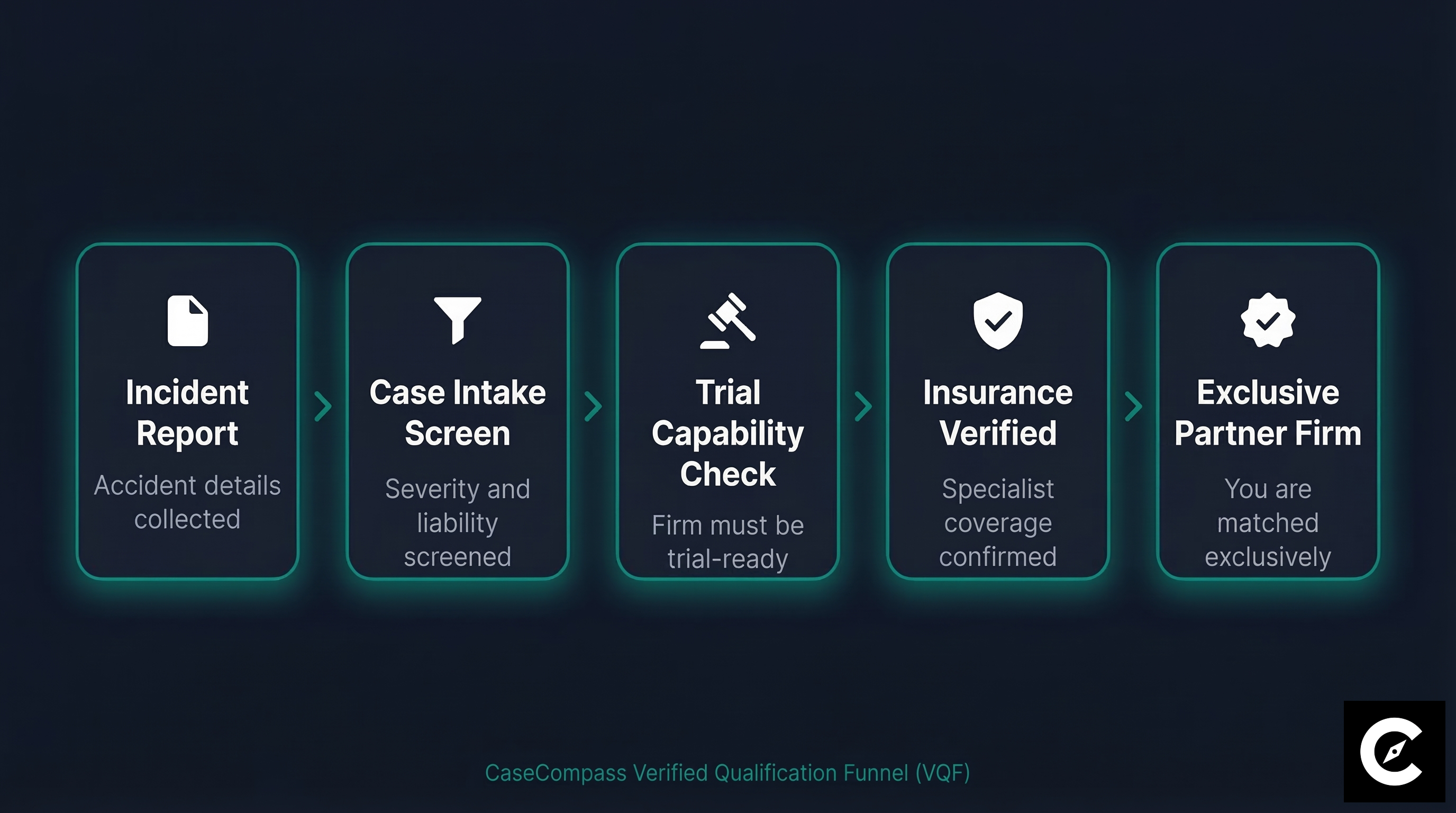
How We Match You with a Verified Firm
Not all law firms are qualified to handle serious injury cases. As shown in our qualification pipeline below, CaseCompass strictly filters incoming cases to ensure you are connected exclusively with a highly-vetted, specialized verified partner firm capable of taking your case to trial if an insurance company refuses to settle fairly.
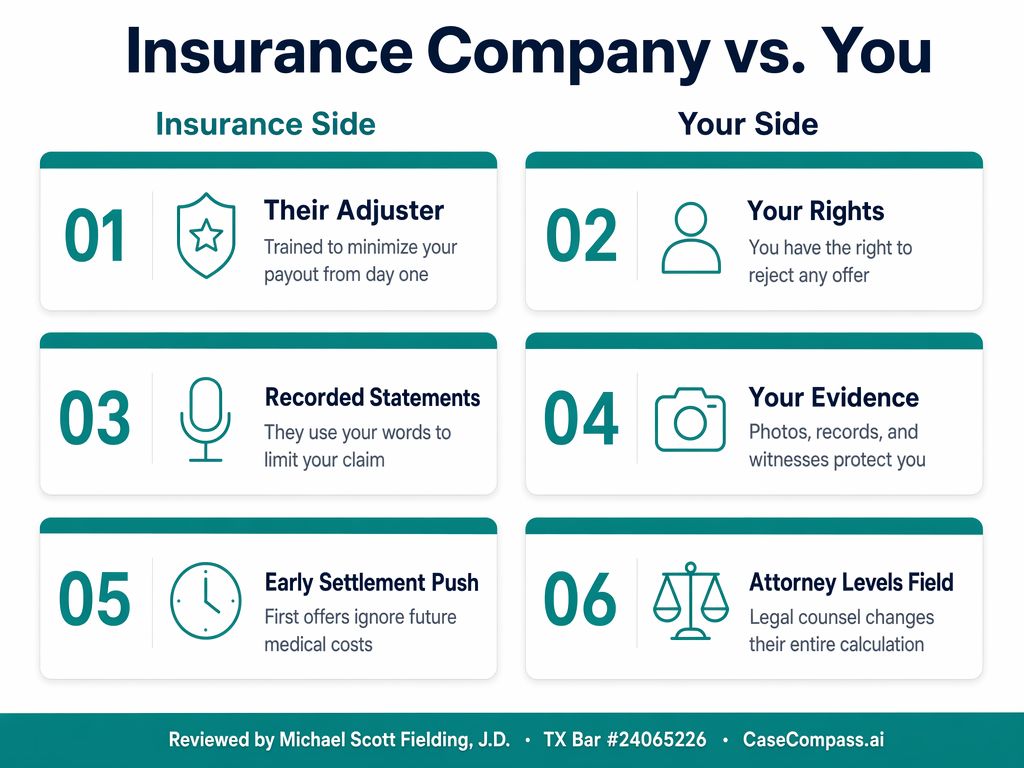
How much is your case worth in Texas?
Statewide settlement data by injury type, verified by Michael Scott Fielding, J.D..
| Metric | Value | Source |
|---|---|---|
| Texas statute of limitations — personal injury | 2 years from accident date | [Tex. Civ. Prac. & Rem. Code § 16.003](https://statutes.capitol.texas.gov/Docs/CP/htm/CP.16.htm) |
| Texas motorcyclist fatalities (2024 statewide) | 585 (37% without helmets) | [TxDOT Crash Records 2024](https://www.txdot.gov/data-maps/crash-reports-records/motor-vehicle-crash-statistics.html) |
| Helmet law — Texas | Required under 21; 21+ exempt with safety course or $10K medical coverage | [Tex. Transp. Code § 661.003](https://statutes.capitol.texas.gov/Docs/TN/htm/TN.661.htm) |
| Lane splitting legality — Texas | Not legal (no statute authorizing it) | Texas Department of Public Safety |
| Modified comparative negligence threshold | 51% — exceed this and you recover nothing | [Tex. Civ. Prac. & Rem. Code § 33.001](https://statutes.capitol.texas.gov/Docs/CP/htm/CP.33.htm) |
| Average ER visit cost — no insurance | ~$2,600 | UnitedHealthcare / Mira |
Common Mistakes to Avoid
- 1
Mistake #1: Assuming your claim is weaker because you weren't wearing a helmet. Texas allows riders 21+ to ride without a helmet under specific conditions. Not wearing a helmet is not illegal for eligible riders. However, insurers argue that helmet non-use contributed to injury severity under comparative negligence. This is a damages argument, not a liability argument
your claim is not eliminated. Document everything and retain an attorney who understands motorcycle-specific comparative fault defenses.
- 2
Mistake #2: Accepting fault because you were on a motorcycle. Adjusters exploit the cultural bias against motorcycle riders. They assign inflated fault percentages for 'failure to take evasive action' or 'excessive speed'
even when the car driver failed to check mirrors or ran a red light. In most motorcycle crashes, the car driver's failure to see the rider is the primary cause. Do not accept any fault assignment without legal review. Witness statements and physical evidence often tell a different story than the adjuster's narrative.
- 3
Mistake #3: Not photographing the helmet and motorcycle immediately. Your helmet's condition (scuff marks, cracks, visor damage) proves you were wearing it
and the severity of head impact. Your motorcycle's damage pattern shows the angle and force of impact. Both are critical evidence for your attorney and any accident reconstruction expert. Photograph your helmet and motorcycle from multiple angles before anyone moves or repairs them.
- 4
Mistake #4: Delaying medical treatment because injuries seem manageable. Adrenaline after a motorcycle crash can mask fractures, internal bleeding, and concussion symptoms for hours. Riders walk away from crashes and collapse later. A same-day ER visit with imaging establishes the full scope of injuries. A 3-day treatment gap gives the insurer grounds to dispute causation. Go to the ER the same day
even if you feel functional.
Why Work With a CaseCompass Attorney
No upfront cost. No obligation. Just answers.
Your Consultation Is Always Free
Every attorney on CaseCompass works on contingency — you pay nothing upfront, and nothing at all unless your attorney wins or settles your case.
Government-Sourced, Attorney-Verified
Every guide is built from official state records, federal statutes, and government data — then reviewed by a licensed California attorney with a verified clean disciplinary record.
Re-Verified Every 90 Days
Content is reviewed on a 90-day cycle with the reviewing attorney's name and Bar number listed transparently on every page.
24/7 Intake — English & Spanish
Every CaseCompass partner firm provides round-the-clock intake in both English and Spanish so you can get answers the moment you need them.
Your Privacy Is Protected
We never share your personal information without your explicit consent — your eligibility check is free, confidential, and carries zero obligation.
More Help
How to Choose the Right Lawyer
Bar verification, consultation questions, red flags, and contingency fee structures under Texas law.
Find a Trusted Auto Body Shop
Vetted collision repair shops in Dallas — insurance-approved and independently rated.
Lowball Settlement Offers
How to detect and counter a lowball insurance offer after your accident.
Insurance Claim Denied?
Steps to take when your insurance company denies or undervalues your claim.
Frequently Asked Questions
What should I do after a motorcycle accident in Dallas?▼
Call 911, photograph the scene and your helmet, get the other driver's insurance information, collect witness contacts, and seek emergency medical care the same day. Do not give a recorded statement to any insurer. Contact a motorcycle accident attorney within 48 hours to preserve evidence and challenge any fault assignment.
What if I wasn't wearing a helmet during my motorcycle accident in Texas?▼
If you are 21+ and meet Texas's exemption requirements (safety course or $10,000 medical coverage), riding without a helmet is legal. However, insurers may argue helmet non-use contributed to injury severity under comparative negligence. This reduces your compensation but does not eliminate your claim. An attorney can challenge this argument.
Is a motorcycle accident claim different from a car accident claim in Texas?▼
Yes. Motorcycle claims face anti-rider bias from adjusters and jurors who assume riders were reckless. Injuries are typically more severe due to the lack of vehicle protection. Insurers aggressively assign fault for speed, helmet non-use, and lane position. Specialized legal counsel experienced in motorcycle cases is essential.
How much is a motorcycle accident settlement worth in Dallas?▼
Road rash and soft tissue injuries may settle for $15,000–$50,000. Fractures and surgeries range from $50,000 to $250,000. Spinal cord injuries and traumatic brain injuries can exceed $500,000. Fielding Law recovered a $3.27M jury verdict in a motorcycle accident case involving a commercial van making an unsafe left turn.
Can I still recover damages if I was partially at fault?▼
Yes, as long as your fault does not exceed 50%. Texas reduces your compensation proportionally. At 20% fault on a $200,000 claim, you recover $160,000. At 51% fault, you recover nothing. An attorney can challenge inflated fault percentages that adjusters assign to motorcycle riders.
Is lane splitting legal in Texas?▼
No. Texas has no statute authorizing lane splitting (riding between lanes of traffic). If you were lane splitting at the time of the crash, it will be used against you in fault allocation. However, lane splitting alone does not make you 100% at fault — the other driver may still bear primary responsibility.
What if the car driver didn't see me on my motorcycle?▼
Failure to see a motorcycle is not a defense — it is evidence of negligence. Drivers owe a duty to check mirrors, blind spots, and intersections before turning or changing lanes. 'I didn't see the motorcycle' is an admission of failure to exercise reasonable care, not an excuse. Document the driver's actions with witness statements and physical evidence.
How long does a motorcycle accident claim take to settle in Dallas?▼
Simple cases may settle in 4–8 months. Severe injuries requiring surgery or long-term rehabilitation take 12–24 months. Do not rush settlement before reaching Maximum Medical Improvement — motorcycle injuries often require multiple surgeries and extended physical therapy. Early settlement permanently caps your recovery.
Sources & Citations
Check My Case Value & Protect My Claim →
Free · No obligation · 24/7 intake open
⚡ Free · No Obligation
See If You Qualify in 60 Seconds
Step 1 — Select accident type
What type of accident were you in?