


Accidents move fast. This guide doesn't. Every step below is attorney-reviewed and specific to Dallas, Texas law — so you don't miss what matters.
If you were injured in a rideshare accident in Dallas, your compensation depends on which insurance phase was active at the time of the crash. Texas gives you 2 years to file under Tex. Civ. Prac. & Rem. Code § 16.003.
The three coverage phases:
- Phase 1 (app on, no match): Driver's personal insurance applies. Uber/Lyft provide contingent coverage of $50,000/$100,000/$25,000
- Phase 2 (match accepted, en route to pickup): Uber/Lyft provide $1 million in liability coverage
- Phase 3 (passenger in vehicle): Full $1 million liability + $1 million UM/UIM coverage from Uber/Lyft
Rideshare insurers investigate which phase was active before they investigate your injuries. Their goal is to classify your crash as Phase 1 to reduce available coverage from $1 million to as little as $50,000.
Do not accept any in-app settlement offer. Contact a Dallas rideshare accident attorney before filing any claim.
Quick Answer — Source Index4§ 2 LAW◎ 2 GOVclaim-level sources
Texas Statute of Limitations — Tex. Civ. Prac. & Rem. Code Ch. 16Texas Statute of Limitations✓ Official (source-only)
Texas Comparative Fault — Tex. Civ. Prac. & Rem. Code Ch. 33Texas Comparative Fault✓ Official (source-only)
TxDOT Motor Vehicle Crash Statistics 2024TxDOT Motor Vehicle Crash Statistics 2024✓ Official (source-only)
Texas Department of Insurance — Auto Insurance Consumer GuideTexas Department of Insurance✓ Official (source-only)
Check My Case Value & Protect My Claim →
Free · No obligation · 24/7 intake open
⚡ Free · No Obligation
See If You Qualify in 60 Seconds
Step 1 — Select accident type
What type of accident were you in?
Your Rideshare Accident
Tap each step as you complete it — your progress saves automatically.
DFW International Airport and Dallas Love Field generate tens of thousands of rideshare trips daily, making rideshare accidents an increasingly common injury claim in Dallas. Uber and Lyft carry up to $1 million in coverage — but only during certain phases of the trip.
Why This Matters — And What Insurers Won't Tell You
Rideshare insurers investigate coverage phase before they investigate your injuries — their goal is to classify your crash as Phase 1, reducing available coverage from $1 million to as little as $50,000. Adjusters from both the rideshare company's insurer and the driver's personal insurer will point fingers at each other, each arguing the other policy applies.
Uber and Lyft make in-app settlement offers within 72 hours of a reported crash, before your medical picture is complete. These offers are designed to resolve the claim quickly at a fraction of its value. Accepting an in-app offer waives your right to pursue the full $1 million policy.
The driver's personal auto insurance almost always excludes commercial rideshare activity. If the crash occurred during Phase 1 and neither the personal policy nor the rideshare contingent coverage fully applies, you may face a coverage gap. An attorney who understands rideshare insurance architecture can identify the correct policy, prevent phase misclassification, and block premature settlement offers.
Dallas County recorded 46,257 total crashes in 2024, with DFW Airport and Love Field corridors among the highest rideshare-density zones.
Rideshare crash frequency correlates directly with airport proximity and nightlife districts. Deep Ellum, Uptown, and the DFW Airport connector roads see disproportionate rideshare accident volume.
Source: TxDOT Crash Records 2024
Were you hurt in this type of accident?
Find out if you may be entitled to compensation — it's free and takes 60 seconds.
Check My Eligibility →What To Do Next
- 1
Call 911 and ensure a CR-3 crash report is filed. The police report must document whether the rideshare driver had a passenger, was en route to a pickup, or had the app on — this determines which insurance phase applies.
- 2
Screenshot the Uber or Lyft app immediately — your ride status, trip details, driver name, and vehicle information. This screenshot is critical evidence of which coverage phase was active at the time of the crash.
- 3
Photograph all vehicle damage, your injuries, road conditions, and the positions of all vehicles. Get the rideshare driver's personal insurance information in addition to the rideshare company details.
- 4
Get witness names and phone numbers. Independent witnesses can confirm whether you were a passenger, whether the driver was en route to a pickup, or whether the app was in driver mode — all of which determine coverage.
- 5
Seek medical treatment the same day. Do not wait for the rideshare company or their insurer to authorize treatment. Your health comes first, and a same-day medical record establishes causation.
- 6
Do not accept any in-app settlement offer from Uber or Lyft. These offers are made before your medical treatment is complete and typically represent a fraction of your claim's value. Contact a rideshare accident attorney first.
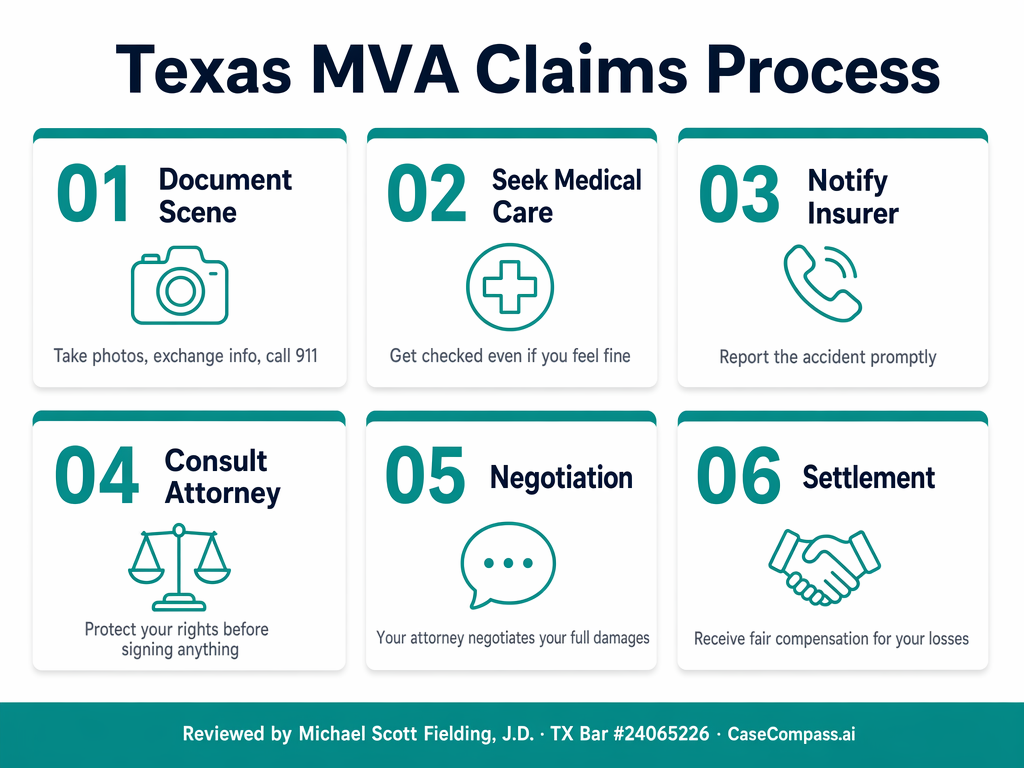
How We Match You with a Verified Firm
Not all law firms are qualified to handle serious injury cases. As shown in our qualification pipeline below, CaseCompass strictly filters incoming cases to ensure you are connected exclusively with a highly-vetted, specialized verified partner firm capable of taking your case to trial if an insurance company refuses to settle fairly.
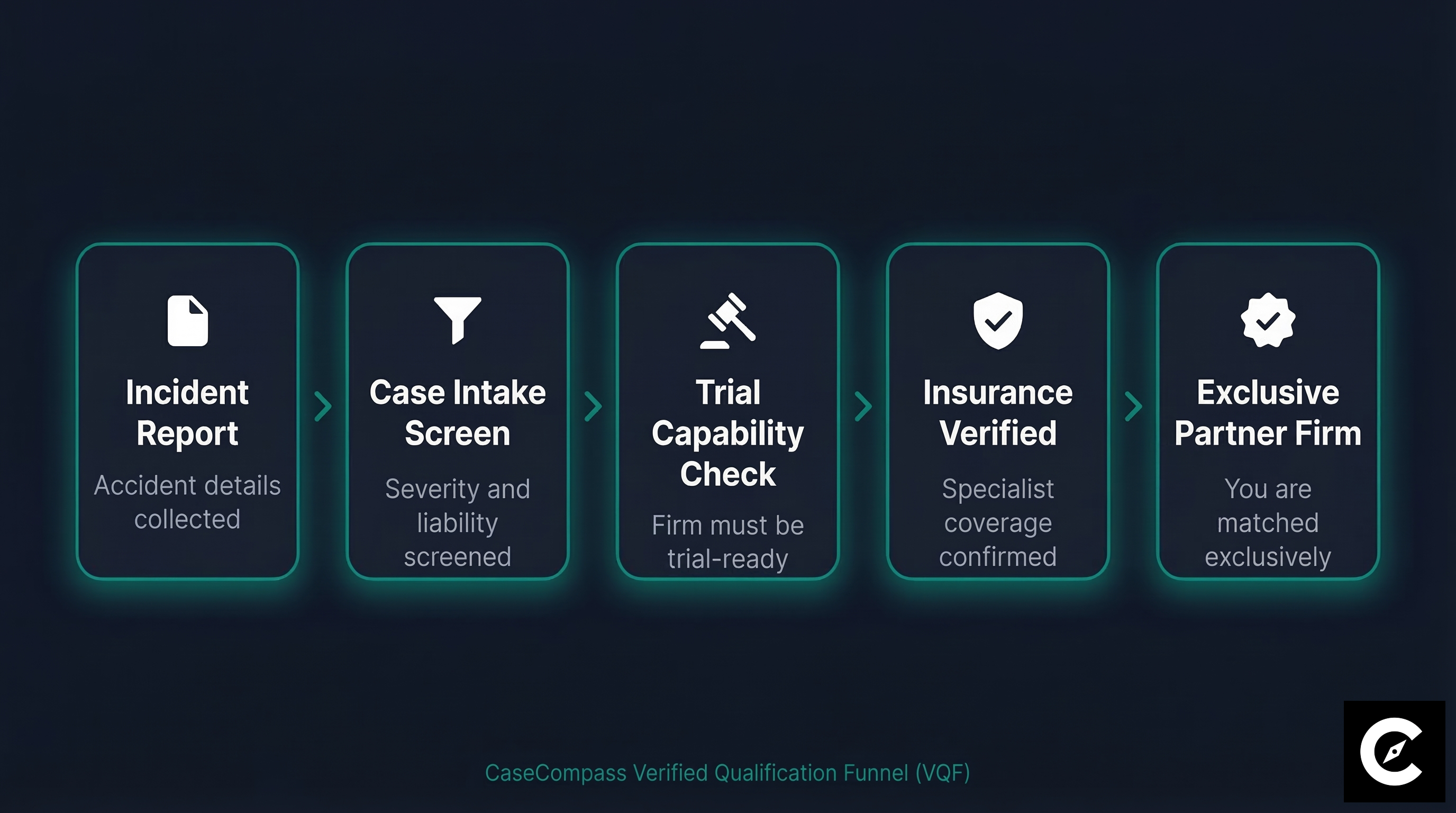
How much is your case worth in Texas?
Statewide settlement data by injury type, verified by Michael Scott Fielding, J.D..
| Metric | Value | Source |
|---|---|---|
| Texas statute of limitations — personal injury | 2 years from accident date | [Tex. Civ. Prac. & Rem. Code § 16.003](https://statutes.capitol.texas.gov/Docs/CP/htm/CP.16.htm) |
| Phase 1 coverage (app on, no match) | $50,000/$100,000/$25,000 (contingent) | Uber/Lyft insurance disclosures |
| Phase 2–3 coverage (match accepted through trip end) | $1,000,000 liability + $1,000,000 UM/UIM | Uber/Lyft insurance disclosures |
| Modified comparative negligence threshold | 51% — exceed this and you recover nothing | [Tex. Civ. Prac. & Rem. Code § 33.001](https://statutes.capitol.texas.gov/Docs/CP/htm/CP.33.htm) |
| Average ER visit cost — no insurance | ~$2,600 | UnitedHealthcare / Mira |
Common Mistakes to Avoid
- 1
Mistake #1: Accepting the in-app settlement offer. Uber and Lyft push settlement offers through their app within days of a crash
before MRIs are ordered, before surgery is recommended, before the full scope of injuries is known. These offers are designed to close claims quickly. Once you accept, you waive rights to the full $1 million policy. Ignore in-app offers entirely. Consult an attorney before responding to any settlement communication.
- 2
Mistake #2: Not documenting the app status at the time of the crash. The difference between Phase 1 and Phase 3 coverage is the difference between $50,000 and $1,000,000. Rideshare companies control the app data. If you don't screenshot your ride status immediately after the crash, you lose the only independent proof of which phase was active. Screenshot the app before closing it. Your attorney will subpoena server-side data, but your screenshot is immediate evidence.
- 3
Mistake #3: Assuming the rideshare driver's personal insurance will cover you. Most personal auto policies exclude coverage during commercial rideshare activity. If the crash happened during Phase 1, the personal policy likely denies coverage, and the rideshare contingent policy may argue it doesn't apply either. This creates a coverage gap that victims don't expect. An attorney can identify the correct policy and prevent both insurers from denying your claim.
- 4
Mistake #4: Filing a claim only against the rideshare company. The rideshare driver, the other involved drivers, and the rideshare company may all carry separate policies. Filing against only one party limits available coverage. In multi-vehicle rideshare crashes, there may be $2–3 million in combined coverage across all defendants. Your attorney should identify all potentially liable parties and all available policies.
Why Work With a CaseCompass Attorney
No upfront cost. No obligation. Just answers.
Your Consultation Is Always Free
Every attorney on CaseCompass works on contingency — you pay nothing upfront, and nothing at all unless your attorney wins or settles your case.
Government-Sourced, Attorney-Verified
Every guide is built from official state records, federal statutes, and government data — then reviewed by a licensed California attorney with a verified clean disciplinary record.
Re-Verified Every 90 Days
Content is reviewed on a 90-day cycle with the reviewing attorney's name and Bar number listed transparently on every page.
24/7 Intake — English & Spanish
Every CaseCompass partner firm provides round-the-clock intake in both English and Spanish so you can get answers the moment you need them.
Your Privacy Is Protected
We never share your personal information without your explicit consent — your eligibility check is free, confidential, and carries zero obligation.
More Help
How to Choose the Right Lawyer
Bar verification, consultation questions, red flags, and contingency fee structures under Texas law.
Find a Trusted Auto Body Shop
Vetted collision repair shops in Dallas — insurance-approved and independently rated.
Lowball Settlement Offers
How to detect and counter a lowball insurance offer after your accident.
Insurance Claim Denied?
Steps to take when your insurance company denies or undervalues your claim.
Frequently Asked Questions
What do I do if I'm in an Uber or Lyft accident in Dallas?▼
Call 911, screenshot the rideshare app showing your trip status, photograph all damage and injuries, and seek medical care the same day. Do not accept any in-app settlement offer. Report the accident through the app but do not give detailed statements. Contact a rideshare accident attorney within 48 hours.
Does Uber's insurance cover my injuries as a passenger?▼
Yes — if you were a passenger during an active trip (Phase 3), Uber provides $1 million in liability coverage plus $1 million in UM/UIM coverage. This applies regardless of who caused the crash. The coverage amount drops dramatically if the driver was between rides (Phase 1).
What are the insurance coverage levels for rideshare accidents in Texas?▼
Phase 1 (app on, no match): $50,000/$100,000/$25,000 contingent coverage. Phase 2 (en route to pickup): $1 million liability. Phase 3 (passenger in vehicle): $1 million liability plus $1 million UM/UIM. The phase active at the time of the crash determines your available coverage.
Who is liable in a rideshare accident — the driver or the company?▼
Both may be liable. The driver can be personally liable for negligence, while Uber or Lyft's insurance applies based on the trip phase. Other involved drivers may also share fault. Texas's modified comparative negligence rule applies. An attorney should identify all liable parties and available insurance policies.
Should I report a rideshare accident through the app?▼
Yes, report the accident through the Uber or Lyft app to create an official record. However, keep your description brief and factual — do not admit fault, speculate about injuries, or provide detailed statements. Screenshot your trip details before reporting. Any detailed statements should go through your attorney.
Can I sue Uber or Lyft after an accident in Texas?▼
You can file a claim against Uber or Lyft's insurance policy. Suing the company directly is more complex because drivers are classified as independent contractors, not employees. However, the $1 million insurance policy is available regardless of employment classification during Phase 2–3 trips. An attorney can advise on the best approach.
What if the rideshare driver caused the accident?▼
If the rideshare driver was at fault and you were a passenger, the driver's Phase 3 insurance ($1 million) applies. You may also have a claim against the driver personally. If the driver was at fault and you were in another vehicle, coverage depends on which phase was active. Contact an attorney to determine all available policies.
How long does a rideshare accident claim take to settle?▼
Rideshare claims typically take 6–12 months due to coverage phase disputes between the personal insurer and the rideshare insurer. Complex cases with disputed liability or severe injuries can take 12–18 months. Do not accept early in-app offers before reaching Maximum Medical Improvement.
Sources & Citations
Check My Case Value & Protect My Claim →
Free · No obligation · 24/7 intake open
⚡ Free · No Obligation
See If You Qualify in 60 Seconds
Step 1 — Select accident type
What type of accident were you in?