

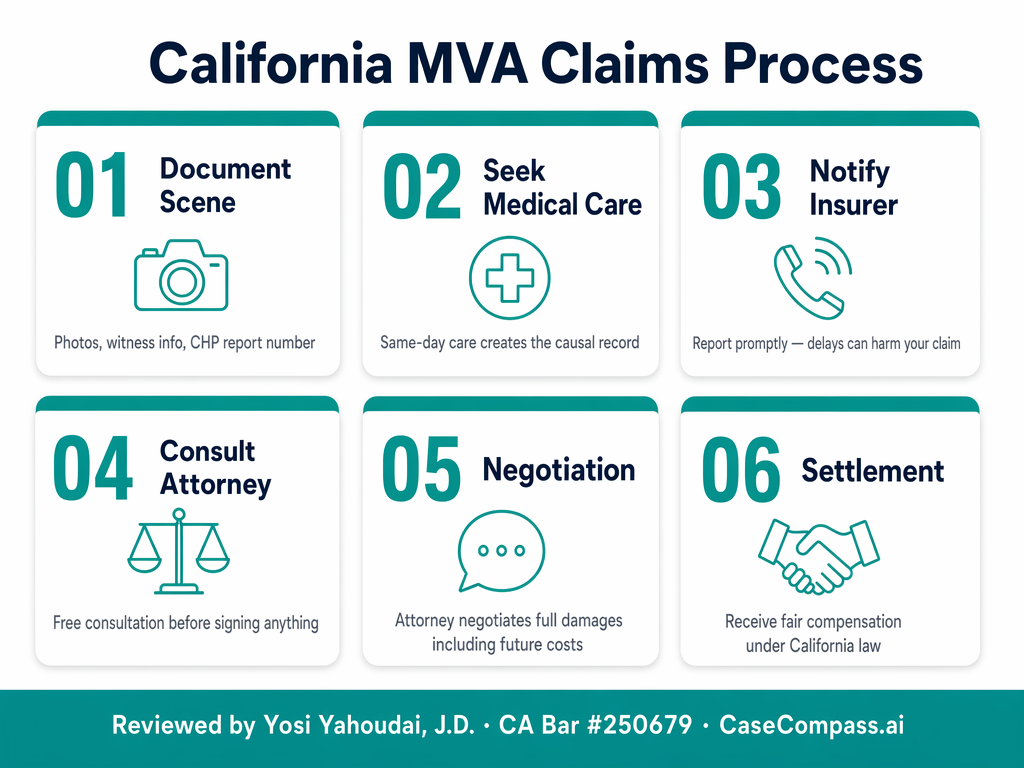
Accidents move fast. This guide doesn't. Every step below is attorney-reviewed and specific to Los Angeles, California law — so you don't miss what matters.
This guide applies to California law only. Laws in other states differ significantly. Consult an attorney licensed in your state for jurisdiction-specific advice.
If you were injured in an Uber or Lyft accident in Los Angeles, your compensation depends on which coverage phase was active at the time of the crash.
- Phase 3 (active trip): Uber and Lyft each carry $1M liability coverage under California PUC § 5431
- Phase 2 (app on, no passenger): $200K contingent coverage applies under CPUC Decision D.13-09-045
- Screenshot the app immediately to document which phase was active
- Report in-app before closing the trip — this preserves the coverage record
- Do not give any recorded statement to any insurer before speaking with an attorney
California law gives you 2 years to file under CCP § 335.1. Coverage phase is the single most important fact in your case — it determines which policy pays and how much is available.
Contact a rideshare accident attorney before your first insurer call.
Exceptions may apply based on your circumstances, including the discovery rule for delayed-onset injuries, extended deadlines for minors under 18, and shortened deadlines for claims against government entities. Consult a licensed California attorney for case-specific guidance.
Quick Answer — Source Index5§ 3 LAW◎ 2 GOVclaim-level sources
California PUC TNC Insurance — Public Utilities Code § 5431California PUC TNC Insurance✓ Official (source-only)
California Statute of Limitations — [CCP § 335.1](https://leginfo.legislature.ca.gov/faces/codes_displaySection.xhtml?sectionNum=335.1.&lawCode=CCP)California Statute of Limitations✓ Official (source-only)
California AB 1107 — Updated Min. Insurance (Jan. 2025)California AB 1107✓ Official (source-only)
CHP SWITRS — LA County Crash DataCHP SWITRS✓ Official (source-only)
HCUP — Emergency Department Cost DataHCUP✓ Official (source-only)
Check My Case Value & Protect My Claim →
Free · No obligation · 24/7 intake open
⚡ Free · No Obligation
See If You Qualify in 60 Seconds
Step 1 — Select accident type
What type of accident were you in?
Your Rideshare Accident
Tap each step as you complete it — your progress saves automatically.
Los Angeles is the largest rideshare market in the US by trip volume, with hundreds of thousands of Uber and Lyft rides daily across LAX, Hollywood, and downtown LA.
Why This Matters — And What Insurers Won't Tell You
Rideshare insurers investigate coverage phase before they investigate your injuries — their goal is to classify your crash as Phase 1 or 2, reducing available coverage from $1 million to as little as $30,000 under AB 1107. Adjusters make in-app settlement offers within 72 hours, before your medical picture is complete and before phase is confirmed. Accepting that offer permanently waives your right to pursue the TNC's $1 million policy under California PUC § 5431.
Los Angeles County recorded 54,347 injury traffic crashes in 2022 — the highest of any county in California.
Rideshare vehicles are concentrated in the highest-density corridors — downtown LA, Hollywood, and LAX — where injury crash rates are most severe.
Source: California Highway Patrol SWITRS (switrs.dot.ca.gov)
Were you hurt in this type of accident?
Find out if you may be entitled to compensation — it's free and takes 60 seconds.
Check My Eligibility →What To Do Next
- 1
Screenshot the Uber or Lyft app showing your active trip immediately — this is proof of which coverage phase applies. If the app closes or the trip is cancelled, the coverage phase becomes disputed.
- 2
Photograph both vehicles, all visible injuries, the accident scene, road conditions, and any traffic signals. Take a photo of the rideshare driver's vehicle plate and the app screen showing driver name and vehicle.
- 3
Report the accident through the Uber or Lyft in-app safety feature. This timestamps the incident and triggers the platform's insurance review within their system.
- 4
Call 911. In California, any accident with injury must be reported to law enforcement. Your police report (CHP or LAPD) is required evidence for both the insurance claim and any lawsuit.
- 5
Contact a Los Angeles personal injury attorney before giving any recorded statement to Uber's, Lyft's, or the at-fault driver's insurer. California law does not require you to give a recorded statement to an opposing party's insurer.
Expert Insight from Our Legal Team
Written by Our Legal Team — Los Angeles Rideshare Accident Lawyers · Reviewed by Yosi Yahoudai, J.D. · Adapted for CaseCompass
1The Coverage Phase Blind Spot Most Victims Miss▼
The most dangerous misconception we encounter is that a rideshare crash is just a regular car accident with a bigger insurance policy. It is not. What determines your entire recovery is the coverage phase active at the moment of impact — and Uber and Lyft's investigation teams know this better than most victims do. We call our approach the Coverage Phase Confirmation Protocol: before anything else, we pull the CPUC trip record and platform activity log to establish exactly which policy applies. The most heartbreaking cases we handle are victims who arrive a week after the crash — app closed, trip record overwritten by subsequent driver activity. At that point, Uber argues Phase 1 applies: the driver's personal minimum. That coverage gap has cost clients hundreds of thousands of dollars.
2What We Do the Moment You Retain Us▼
When a client retains us after a rideshare crash, we immediately do three things: pull the CPUC trip record to confirm coverage phase, send a platform data preservation demand to lock in GPS and app activity logs, and open a parallel claim against the rideshare insurer before they build their denial narrative. We do not wait. The rideshare insurance team already has a 24-hour head start — they know the trip status and have the driver's statement. Every recorded statement a victim gives without counsel is a gift to the insurer. We have seen clear $150,000 cases reduced to $22,000 settlements because the victim described their pain as 'minor' before the full extent of their injuries was known.
3The Myth California Insurers Actively Promote▼
A myth the insurance industry promotes: 'Uber and Lyft always cover their drivers.' They do not. The coverage ladder under California Public Utilities Code § 5431 is engineered to minimize payouts at every stage below Phase 3. What we actually see in practice: Phase 1 (app off) pays the driver's personal minimum — often just $30,000 — and that policy commonly carries a rideshare exclusion that voids coverage entirely. Phase 2 (app on, no passenger) pays $200,000, but only as contingent coverage after the driver's policy denies first. Phase 3 (active trip) triggers $1 million primary. Insurers fight hard to push crashes into Phase 1 or Phase 2. We counter this with platform GPS data and timestamped trip records.
4Two Steps the Generic Guides Always Miss▼
The standard advice — 'call 911, exchange information, see a doctor' — is correct but dangerously incomplete. In our experience handling hundreds of LAPD and CHP rideshare crash reports, two steps are almost always missed. First: screenshot the rideshare app before anything else — before you exit the vehicle. That screenshot is your coverage phase proof. Once the app closes or the trip is cancelled, Uber and Lyft's systems may not preserve Phase 3 confirmation in a format your attorney can use in court. Second: do not rely on the in-app accident report alone. We have seen Uber's in-app tool generate reports that frame serious crashes as 'minor contact.' File independently through law enforcement and your own insurer.
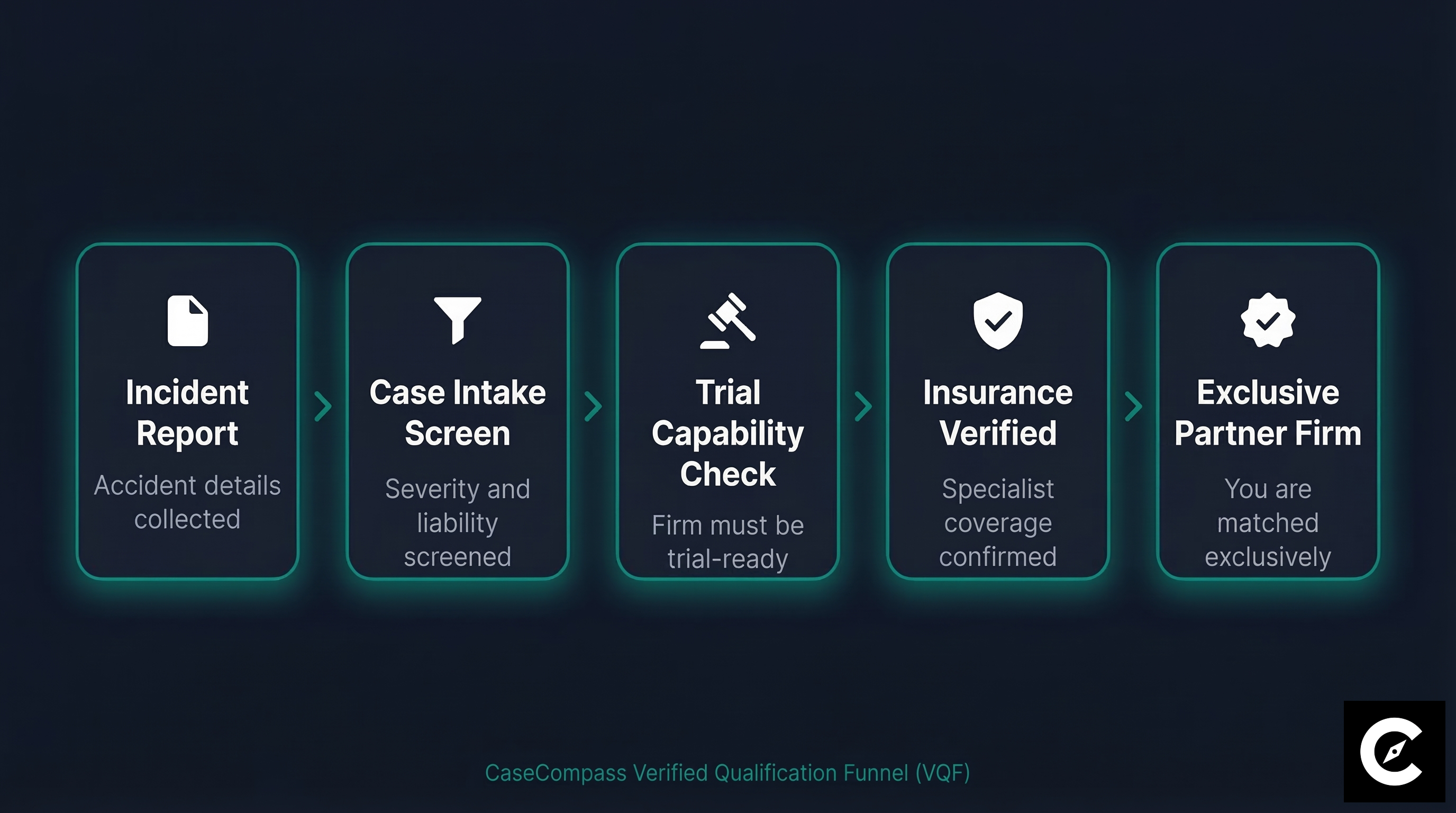
How We Match You with a Verified Firm
Not all law firms are qualified to handle serious injury cases. As shown in our qualification pipeline below, CaseCompass strictly filters incoming cases to ensure you are connected exclusively with a highly-vetted, specialized verified partner firm capable of taking your case to trial if an insurance company refuses to settle fairly.
How much is your case worth in California?
Statewide settlement data by injury type, verified by Yosi Yahoudai, J.D..
| Metric | Value | Source |
|---|---|---|
| Rideshare liability — active trip (Phase 3) | $1,000,000 | statuteCalifornia Public Utilities Code § 5431(as of 2025) |
| Rideshare liability — app on, no passenger (Phase 2) | $200,000 contingent coverage | .gov ✓CPUC Decision D.13-09-045(as of 2013) |
| California statute of limitations — personal injury | 2 years from accident date | statuteCalifornia Code of Civil Procedure § 335.1(as of 2025) |
| Average ER visit cost — Los Angeles County | $4,100 | .gov ✓HCUP (hcupnet.ahrq.gov)(as of 2023) |
| California minimum auto insurance (as of Jan. 1, 2025) | $30,000/$60,000 | statuteCalifornia Vehicle Code § 16056 (AB 1107)(as of 2025) |
| Minor soft tissue injury multiplier — Los Angeles | 1.5x–3x medical costs | firm dataAttorney estimate · Yosi Yahoudai, J.D. · CA Bar #250679(as of 2025) |
| Moderate injury (surgery/fracture) multiplier | 3x–6x medical costs | firm dataAttorney estimate · Yosi Yahoudai, J.D. · CA Bar #250679(as of 2025) |
Settlement ranges are estimated from Los Angeles County rideshare accident claims, 2020–2025. Multi-tier insurance coverage complicates valuation. Reviewed by Yosi Yahoudai, J.D., California Bar #250679. Individual results vary.
Common Mistakes to Avoid
- 1
Mistake #1: Closing the app before screenshotting the active trip. Uber and Lyft's systems log trip termination timestamps
if the trip shows as closed before the crash report is filed, the insurer argues Phase 2 applies and your coverage exposure drops from $1M to $200K. Screenshot the app immediately, before exiting the vehicle or calling anyone.
- 2
Mistake #2: Filing only against the driver's personal auto policy. California's $1M TNC coverage under PUC § 5431 does not activate automatically
you must identify and file against the correct policy layer. Filing against the driver's personal policy alone allows the larger TNC policy to remain unpaid. An attorney opens the parallel claim against the platform insurer from day one.
- 3
Mistake #3: Waiting more than 72 hours to seek medical care. California adjusters are trained to flag treatment gaps as evidence that injuries were not caused by the accident
a gap of 3 or more days is routinely used to dispute causation entirely. Seek care the same day; every day of delay is a documented gap the insurer will use.
- 4
Mistake #4: Accepting an in-app settlement prompt from Uber or Lyft. These prompts appear within 24–48 hours and are calibrated to close claims before victims understand what coverage is available. Acceptance is a permanent release
your claim is closed even if injuries worsen. Do not respond to any in-app settlement offer without first speaking to an attorney.
- 5
Mistake #5: Giving the rideshare driver's insurer a recorded statement. The driver's personal insurer is an adverse party. California law does not require you to cooperate with their investigation. In our experience, recorded statements given by unrepresented victims are used verbatim in coverage phase disputes and settlement negotiations. Decline any recorded statement request until you have retained counsel.
Why Work With a CaseCompass Attorney
No upfront cost. No obligation. Just answers.
Your Consultation Is Always Free
Every attorney on CaseCompass works on contingency — you pay nothing upfront, and nothing at all unless your attorney wins or settles your case.
Government-Sourced, Attorney-Verified
Every guide is built from official state records, federal statutes, and government data — then reviewed by a licensed California attorney with a verified clean disciplinary record.
Re-Verified Every 90 Days
Content is reviewed on a 90-day cycle with the reviewing attorney's name and Bar number listed transparently on every page.
24/7 Intake — English & Spanish
Every CaseCompass partner firm provides round-the-clock intake in both English and Spanish so you can get answers the moment you need them.
Your Privacy Is Protected
We never share your personal information without your explicit consent — your eligibility check is free, confidential, and carries zero obligation.
More Help
How to Choose the Right Lawyer
Bar verification, consultation questions, red flags, and contingency fee structures under California law.
Find a Trusted Auto Body Shop
Vetted collision repair shops in Los Angeles — insurance-approved and independently rated.
Lowball Settlement Offers
How to detect and counter a lowball insurance offer after your accident.
Insurance Claim Denied?
Steps to take when your insurance company denies or undervalues your claim.
Frequently Asked Questions
Who pays if I'm injured as a passenger in an Uber or Lyft in Los Angeles?▼
If your trip was active (Phase 3), Uber and Lyft are each required by California law to carry $1 million in primary liability coverage. As a passenger, your fault is typically zero. You file directly against the rideshare company's insurer — not the driver personally. An attorney confirms coverage and files the correct claim.
What is California's rideshare insurance law?▼
California Public Utilities Code § 5431, enforced by the CPUC, requires rideshare companies to carry $1 million in primary liability coverage during an active trip and $200,000 in contingent coverage when the app is on with no passenger. California was the first state to enact TNC insurance laws and sets the highest coverage requirements in the US.
How long do I have to file a rideshare accident claim in California?▼
California's statute of limitations for personal injury is 2 years from the accident date under CCP § 335.1. However, rideshare companies preserve trip data for a limited window. Contact an attorney within 30 days to ensure GPS records, driver logs, and in-app safety reports are preserved before they are deleted.
What if the Uber driver was off-duty and caused the accident?▼
If the app was completely off (Phase 1), only the driver's personal auto insurance applies — not Uber's or Lyft's policy. California now requires a minimum of $30,000/$60,000 in bodily injury liability coverage under AB 1107. If your damages exceed those limits, your own uninsured/underinsured motorist (UIM) coverage may apply.
Can I sue Uber or Lyft directly in California?▼
You can pursue a claim against the platform's insurer directly. Suing Uber or Lyft as a corporate entity is more complex — California courts treat TNC drivers as independent contractors, limiting direct corporate liability. If the platform failed to screen a negligent driver, additional claims may be viable. An attorney evaluates this per case.
Does California's comparative negligence law affect my rideshare claim?▼
Yes. California follows Pure Comparative Negligence, meaning your compensation is reduced by your percentage of fault. As a rideshare passenger, your fault is almost always zero. If you were another driver injured by a rideshare vehicle, your share of fault will be assessed and will reduce your recovery proportionally — but will not eliminate it entirely.
What should I do immediately after a rideshare crash in Los Angeles?▼
Screenshot the Uber or Lyft app before anything else — this preserves your coverage phase record. Call 911 and report in-app. Photograph both vehicles, injuries, and the scene. Do not give a recorded statement to any insurer. Contact an attorney within 24 hours to send a data preservation demand before trip records are deleted.
Can I file a claim against both the rideshare company and the driver?▼
You file against the rideshare insurer, not typically as a direct corporate lawsuit. Uber and Lyft drivers are independent contractors under California law, limiting direct corporate liability. During an active Phase 3 trip, the $1M platform policy applies directly. An attorney determines which claim structure maximizes your total recovery.
Sources & Citations
- statute[1] California PUC TNC Insurance — Public Utilities Code § 5431 ↗
- statute[2] California Statute of Limitations — [CCP § 335.1](https://leginfo.legislature.ca.gov/faces/codes_displaySection.xhtml?sectionNum=335.1.&lawCode=CCP) ↗
- statute[3] California AB 1107 — Updated Min. Insurance (Jan. 2025) ↗
- .gov[4] CHP SWITRS — LA County Crash Data ↗
- .gov[5] HCUP — Emergency Department Cost Data ↗
Check My Case Value & Protect My Claim →
Free · No obligation · 24/7 intake open
⚡ Free · No Obligation
See If You Qualify in 60 Seconds
Step 1 — Select accident type
What type of accident were you in?