

Accidents move fast. This guide doesn't. Every step below is attorney-reviewed and specific to Los Angeles, California law — so you don't miss what matters.
This guide applies to California law only. Laws in other states differ significantly. Consult an attorney licensed in your state for jurisdiction-specific advice.
If a drunk driver hit you in Los Angeles, you are entitled to pursue both compensatory and punitive damages — punitive awards are uncapped under Civil Code § 3294.
- Criminal vs. civil: The criminal prosecution under Vehicle Code § 23152 is separate — do not wait for it to resolve before filing your civil claim
- BAC threshold: 0.08% establishes legal impairment for adult drivers in California
- Punitive damages: Available when the driver's conduct was malicious, oppressive, or fraudulent
- Statute of limitations: 2 years under CCP § 335.1
LA County recorded 265 alcohol-impaired driving fatalities in 2023, according to UC Berkeley SafeTREC. A DUI conviction in the criminal case strengthens — but is not required for — your civil punitive damages claim.
Retain an attorney immediately to coordinate civil filing with the criminal timeline.
Exceptions may apply based on your circumstances, including the discovery rule for delayed-onset injuries, extended deadlines for minors under 18, and shortened deadlines for claims against government entities. Consult a licensed California attorney for case-specific guidance.
Quick Answer — Source Index6§ 4 LAW◎ 2 GOVclaim-level sources
California DUI Statute — Vehicle Code § 23152California DUI Statute✓ Official (source-only)
California Punitive Damages — [Civil Code § 3294](https://leginfo.legislature.ca.gov/faces/codes_displaySection.xhtml?sectionNum=3294.&lawCode=CIV)California Punitive Damages✓ Official (source-only)
California Implied Consent — Vehicle Code § 23612California Implied Consent✓ Official (source-only)
California Dram Shop Law — BPC § 25602California Dram Shop Law✓ Official (source-only)
[NHTSA FARS](https://www.nhtsa.gov/research-data/fatality-analysis-reporting-system-fars) — California DUI Fatality Data[NHTSA FARS](https://www.nhtsa.gov/research-data/fatality-analysis-reporting-system-fars)✓ Official (source-only)
CHP SWITRS — Alcohol-Involved Crash DataCHP SWITRS✓ Official (source-only)
Check My Case Value & Protect My Claim →
Free · No obligation · 24/7 intake open
⚡ Free · No Obligation
See If You Qualify in 60 Seconds
Step 1 — Select accident type
What type of accident were you in?
Your DUI Accident Checklist
Tap each step as you complete it — your progress saves automatically.
Los Angeles County leads California in DUI-related traffic fatalities, consistently ranking first statewide. The highest-risk windows are 11 PM–3 AM on weekends along Hollywood Boulevard, Sunset Strip, and downtown LA.
Why This Matters — And What Insurers Won't Tell You
Insurers fast-track DUI claims as standard negligence cases, suppressing any discussion of punitive damages — which are not covered by auto liability policies and must come from the defendant's personal assets under California Civil Code § 3294. Early settlement offers resolve only compensatory damages and permanently close the punitive claim, often before BAC evidence and criminal records are accessible through discovery. A confirmed BAC above 0.08% under CVC § 23152(b), combined with the criminal prosecution, creates near-automatic grounds for the malice standard — but only if the civil claim remains open long enough to obtain that evidence.
Los Angeles County recorded 265 alcohol-impaired driving fatalities in 2023 — the most of any county in California.
LAPD, CHP, and the LA County Sheriff's Department collectively arrest more than 20,000 DUI suspects annually across the greater Los Angeles metro.
Source: [UC Berkeley SafeTREC Traffic Safety Facts 2025](https://safetrec.berkeley.edu/2025-safetrec-traffic-safety-facts-alcohol-impaired-and-alcohol-involved-driving) (safetrec.berkeley.edu) — FARS ARF 2023 + SWITRS 2023
Were you hurt in this type of accident?
Find out if you may be entitled to compensation — it's free and takes 60 seconds.
Check My Eligibility →What To Do Next
- 1
Call 911. DUI accidents require law enforcement response. Officers will administer field sobriety tests and chemical (BAC) tests on the impaired driver. The police report and BAC reading are the foundation of your civil claim.
- 2
Do not interact with the impaired driver beyond exchanging insurance and identification information. Do not accept apologies, promises to pay, or any verbal agreements. These are evidence — document everything.
- 3
Photograph the scene: visible alcohol containers, open containers, the driver's behavior and appearance, vehicle damage, your injuries, and any witnesses. If the driver refuses a breathalyzer, note that — California's implied consent law (Vehicle Code § 23612) makes refusal itself evidence of impairment.
- 4
Seek emergency medical care immediately. DUI crashes are high-speed impact events — internal injuries, traumatic brain injuries, and spinal injuries are common and often not immediately apparent.
- 5
Contact a Los Angeles crash specialist within 48 hours. A DUI civil case requires coordination with the criminal prosecution — your attorney can attend the criminal proceedings, obtain the BAC evidence through discovery, and file a civil punitive damages claim in parallel with the criminal case.
How We Match You with a Verified Firm
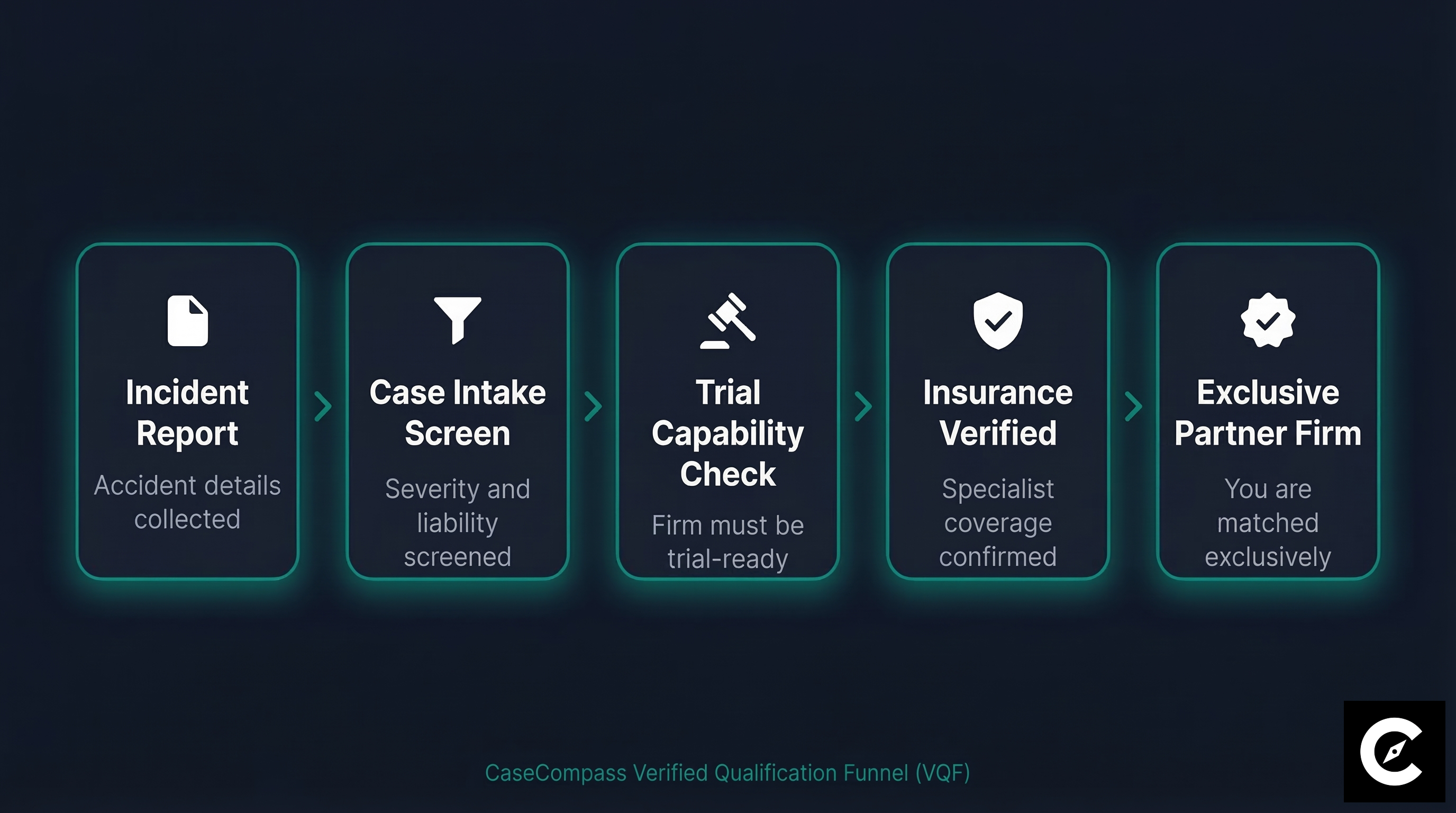
Not all law firms are qualified to handle serious injury cases. As shown in our qualification pipeline below, CaseCompass strictly filters incoming cases to ensure you are connected exclusively with a highly-vetted, specialized verified partner firm capable of taking your case to trial if an insurance company refuses to settle fairly.
How much is your case worth in California?
Statewide settlement data by injury type, verified by Yosi Yahoudai, J.D..
| Metric | Value | Source |
|---|---|---|
| California's legal BAC limit for adult drivers | 0.08% | statuteCalifornia Vehicle Code § 23152(b)(as of 2025) |
| California BAC limit — commercial vehicle operators | 0.04% | statuteCalifornia Vehicle Code § 23152(d)(as of 2025) |
| Punitive damages available in DUI cases? | Yes — uncapped ([Civil Code § 3294](https://leginfo.legislature.ca.gov/faces/codes_displaySection.xhtml?sectionNum=3294.&lawCode=CIV)) | statuteCalifornia Civil Code § 3294(as of 2025) |
| California statute of limitations — personal injury | 2 years from accident date | statuteCCP § 335.1(as of 2025) |
| DUI first offense penalties (criminal) | Up to 6 months jail + $1,000–$2,600 fines | statuteCalifornia Vehicle Code § 23536(as of 2025) |
| Average ER visit cost — Los Angeles County | $4,100 | .gov ✓HCUP (hcupnet.ahrq.gov)(as of 2023) |
| Severe/catastrophic injury multiplier — DUI cases | 5x–15x+ medical costs (includes punitive) | firm dataAttorney estimate · Yosi Yahoudai, J.D. · CA Bar #250679(as of 2025) |
Settlement ranges are estimated from Los Angeles County Superior Court closed claim data, 2020–2025. Reviewed by Yosi Yahoudai, J.D., California Bar #250679. Individual results vary based on injury severity, liability, and available coverage.
Common Mistakes to Avoid
- 1
Mistake #1: Assuming the criminal case compensates you. The criminal prosecution by the LA County DA's office punishes the driver
it does not pay your medical bills, lost wages, or pain and suffering. The civil lawsuit is a completely separate proceeding that you must initiate. Victims who wait for the criminal case to conclude frequently miss the negotiating window when the defendant is most motivated to settle. Retain civil counsel within 48 hours; the criminal and civil cases can proceed in parallel.
- 2
Mistake #2: Not asserting punitive damages. California Civil Code § 3294 authorizes punitive damages when the defendant acted with malice
and California courts have consistently held that a confirmed DUI satisfies that standard. Punitive damages are uncapped, paid from the defendant's personal assets, and are in addition to compensatory damages. Many general PI attorneys do not routinely assert them in DUI cases. Confirm your attorney will plead § 3294 punitive damages before you retain.
- 3
Mistake #3: Settling before the criminal BAC evidence is in hand. The prosecutor's BAC test, toxicology report, officer dashcam, and field sobriety records are the most damaging evidence in your civil case
and they are not fully accessible until after arraignment, typically 3–6 weeks post-arrest. Settling before these are obtained removes the leverage they provide entirely. Wait for the criminal record to be formally accessible before entering any settlement negotiation.
- 4
Mistake #4: Waiting more than 48 hours to contact an attorney. The criminal arraignment happens within 48–96 hours of arrest. Your attorney needs to appear at that proceeding to preserve civil coordination, access the BAC evidence timeline, and issue preservation demands on dashcam and phone records before the carrier's team can shape the narrative. Contact counsel the same day
every hour of delay is an hour the insurer's team is working unopposed.
- 5
Mistake #5: Accepting the DUI driver's insurer's first offer. Insurers know DUI cases carry punitive exposure that their auto liability policy does not cover
and they rush to settle the compensatory portion cheaply before the victim understands that the defendant personally owes more. Early offers in DUI cases with serious injuries are almost always below the full case value when § 3294 exposure is properly quantified. Do not accept any offer until punitive damages have been formally assessed against the defendant's financial condition.
Why Work With a CaseCompass Attorney
No upfront cost. No obligation. Just answers.
Your Consultation Is Always Free
Every attorney on CaseCompass works on contingency — you pay nothing upfront, and nothing at all unless your attorney wins or settles your case.
Government-Sourced, Attorney-Verified
Every guide is built from official state records, federal statutes, and government data — then reviewed by a licensed California attorney with a verified clean disciplinary record.
Re-Verified Every 90 Days
Content is reviewed on a 90-day cycle with the reviewing attorney's name and Bar number listed transparently on every page.
24/7 Intake — English & Spanish
Every CaseCompass partner firm provides round-the-clock intake in both English and Spanish so you can get answers the moment you need them.
Your Privacy Is Protected
We never share your personal information without your explicit consent — your eligibility check is free, confidential, and carries zero obligation.
More Help
How to Choose the Right Lawyer
Bar verification, consultation questions, red flags, and contingency fee structures under California law.
Find a Trusted Auto Body Shop
Vetted collision repair shops in Los Angeles — insurance-approved and independently rated.
Lowball Settlement Offers
How to detect and counter a lowball insurance offer after your accident.
Insurance Claim Denied?
Steps to take when your insurance company denies or undervalues your claim.
Frequently Asked Questions
Can I sue a drunk driver for punitive damages in California?▼
Yes. California Civil Code § 3294 allows punitive damages when the defendant acted with malice, oppression, or fraud. California courts have consistently held that driving while intoxicated meets the malice standard because the driver knowingly created a substantial risk of harm. Punitive damages are uncapped in California and are calculated based on the defendant's financial condition, not just your injuries.
What is the difference between the criminal DUI case and my civil lawsuit?▼
The criminal case is prosecuted by the Los Angeles County District Attorney's office and punishes the driver with potential jail time, fines, license suspension, and probation. The civil case is your personal lawsuit against the driver (and potentially their employer or the establishment that served them alcohol) to recover compensatory damages — medical bills, lost wages, pain and suffering — and punitive damages. The two cases proceed independently, but evidence from the criminal case strengthens your civil claim.
Can I sue the bar or restaurant that served the drunk driver?▼
Generally no — California's dram shop law (Business and Professions Code § 25602) protects alcohol vendors from liability for injuries caused by intoxicated adults. However, exceptions exist: if the bar knowingly served a visibly intoxicated minor (under 21), they can be held liable under Business and Professions Code § 25602.1. Additionally, social host liability may apply in limited circumstances when a private party host furnished alcohol to a known minor.
How does the DUI criminal conviction help my civil case?▼
A DUI criminal conviction can be used as evidence of negligence per se in your civil case — meaning the driver's violation of Vehicle Code § 23152 establishes that they breached their duty of care. The BAC test results, officer body-cam footage, field sobriety test videos, and the driver's statements to police all become discoverable evidence that strengthens your civil punitive damages claim.
How long do I have to file a DUI accident injury claim in California?▼
2 years from the accident date under CCP § 335.1. However, the criminal case timeline is much shorter — arraignment occurs within 48 hours of arrest. Your attorney should be retained immediately to attend criminal proceedings, preserve evidence, and begin the civil case in parallel.
What should I do at the scene of a DUI accident in Los Angeles?▼
Call 911 immediately. Do not help the driver avoid a sobriety test — California's implied consent law (Vehicle Code § 23612) requires them to submit. Photograph visible signs of impairment: open containers, vehicle damage, and the driver's behavior. Do not accept on-scene promises to pay. Contact an attorney within 24 hours.
What if the drunk driver only had minimum insurance in California?▼
If the DUI driver carries only the California minimum of $30,000 per person under AB 1107 and your damages exceed that limit, your own underinsured motorist (UIM) policy covers the gap. Punitive damages — uncapped under Civil Code § 3294 — are paid from the driver's personal assets, not their insurance. An attorney pursues every available source.
How do punitive damages work in a California DUI civil case?▼
Punitive damages under Civil Code § 3294 are separate from compensatory damages and paid by the defendant personally — not covered by auto liability insurance. The amount is calculated based on the defendant's financial condition and severity of conduct. A confirmed BAC above 0.08% satisfies the malice standard required for a punitive award.
Sources & Citations
- statute[1] California DUI Statute — Vehicle Code § 23152 ↗
- statute[2] California Punitive Damages — [Civil Code § 3294](https://leginfo.legislature.ca.gov/faces/codes_displaySection.xhtml?sectionNum=3294.&lawCode=CIV) ↗
- statute[3] California Implied Consent — Vehicle Code § 23612 ↗
- statute[4] California Dram Shop Law — BPC § 25602 ↗
- .gov[5] [NHTSA FARS](https://www.nhtsa.gov/research-data/fatality-analysis-reporting-system-fars) — California DUI Fatality Data ↗
- .gov[6] CHP SWITRS — Alcohol-Involved Crash Data ↗
Check My Case Value & Protect My Claim →
Free · No obligation · 24/7 intake open
⚡ Free · No Obligation
See If You Qualify in 60 Seconds
Step 1 — Select accident type
What type of accident were you in?