

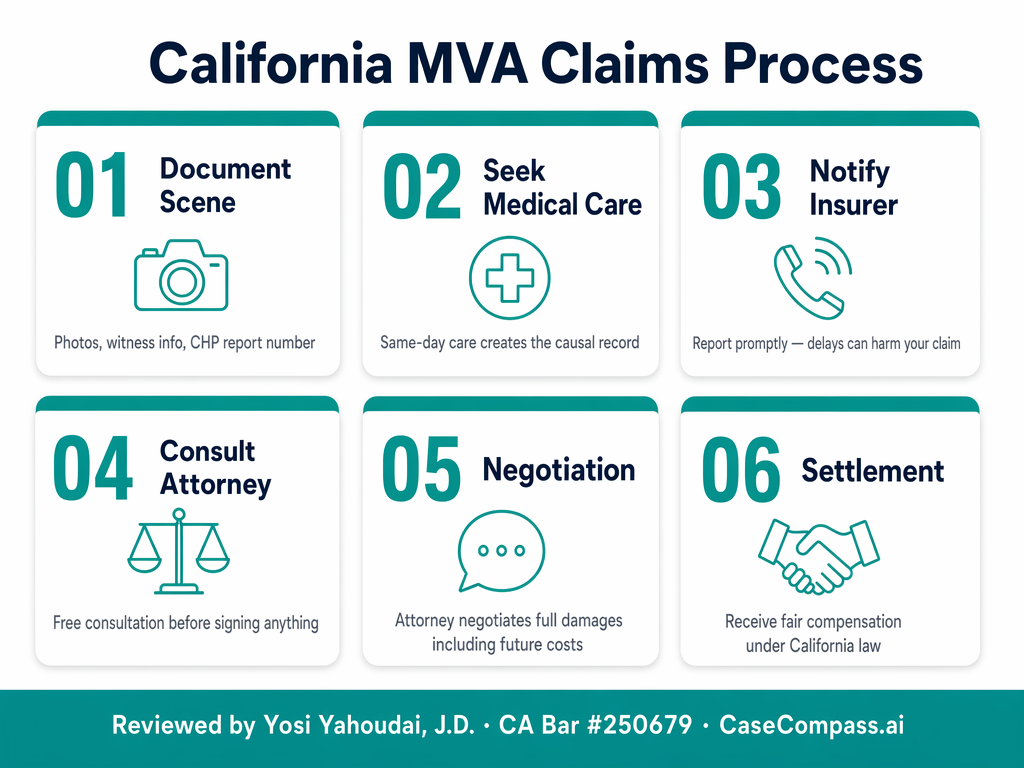
Accidents move fast. This guide doesn't. Every step below is attorney-reviewed and specific to Los Angeles, California law — so you don't miss what matters.
This guide applies to California law only. Laws in other states differ significantly. Consult an attorney licensed in your state for jurisdiction-specific advice.
If you were injured in a Los Angeles car accident, California gives you 2 years to file under CCP § 335.1 and lets you recover compensation even if you were partly at fault.
- Statute of limitations: 2 years from the accident date — missing this date permanently bars your claim
- Pure Comparative Negligence: You can recover even if you were partially at fault — your compensation is reduced by your fault percentage, not eliminated
- New minimums as of Jan. 1, 2025: $30,000 per person / $60,000 per accident under AB 1107
- Call 911: An LAPD or CHP report is required for any injury claim
- Do not give a recorded statement to any insurer before speaking with an attorney
California's Pure Comparative Negligence rule means fault is rarely all-or-nothing — your recovery is reduced by your fault percentage, not eliminated.
Contact a Los Angeles car accident attorney before your first insurer call.
Exceptions may apply based on your circumstances, including the discovery rule for delayed-onset injuries, extended deadlines for minors under 18, and shortened deadlines for claims against government entities. Consult a licensed California attorney for case-specific guidance.
Quick Answer — Source Index5§ 3 LAW◎ 2 GOVclaim-level sources
California Code of Civil Procedure § 335.1 — Statute of LimitationsCalifornia Code of Civil Procedure § 335.1✓ Official (source-only)
California AB 1107 — Updated Minimum Insurance (Jan. 2025)California AB 1107✓ Official (source-only)
CHP SWITRS — LA County Crash DataCHP SWITRS✓ Official (source-only)
California OTS — Traffic Safety DataCalifornia OTS✓ Official (source-only)
California Vehicle Code § 16000 — SR-1 Reporting RequirementCalifornia Vehicle Code § 16000✓ Official (source-only)
Check My Case Value & Protect My Claim →
Free · No obligation · 24/7 intake open
⚡ Free · No Obligation
See If You Qualify in 60 Seconds
Step 1 — Select accident type
What type of accident were you in?
Your Car Accident
Tap each step as you complete it — your progress saves automatically.
Los Angeles County recorded 54,347 injury crashes in 2022 — the highest of any county in California. With over 54,000 injury accidents per year concentrated on the 405, the 10, and the 101, car accidents are the most common personal injury claim in LA.
Why This Matters — And What Insurers Won't Tell You
Insurance adjusters in Los Angeles are trained to assign fault percentages within the first 10 days — before you have retained counsel or reviewed the police report. That initial percentage shapes the entire negotiation. Under California's Pure Comparative Negligence rule, even a 20% fault assignment can reduce a $100,000 settlement to $80,000. Adjusters also make early settlement offers before you have reached Maximum Medical Improvement, locking in a number that excludes future surgery, therapy, and permanent impairment costs that haven't yet been diagnosed.
Los Angeles County recorded 54,347 injury traffic crashes in 2022 — the highest of any county in California.
The 405 Sepulveda Pass has the highest crash concentration per lane-mile in California. The I-10 and US-101 account for a disproportionate share of serious injury crashes in the region.
Source: California Highway Patrol SWITRS (switrs.dot.ca.gov)
Were you hurt in this type of accident?
Find out if you may be entitled to compensation — it's free and takes 60 seconds.
Check My Eligibility →What To Do Next
- 1
Call 911 immediately and wait for LAPD or CHP to arrive. In California, any accident with injury must be reported to law enforcement — your police report number is required for every insurance claim and any future lawsuit.
- 2
Photograph everything before moving any vehicle: both cars, all damage, your injuries, the road conditions, traffic signals, skid marks, and the positions of all vehicles. Take a wide-angle photo of the entire scene from multiple angles.
- 3
Get the other driver's full name, license number, insurance company, policy number, vehicle make/model, and license plate. Photograph their insurance card directly rather than writing down the details.
- 4
Get names and phone numbers of all witnesses. Independent witness statements significantly strengthen fault disputes — adjusters weight them heavily because witnesses have no financial stake.
- 5
See a doctor or go to urgent care the same day, even if you feel fine. Adrenaline masks pain for hours to days. A same-day medical record establishes that your injuries were caused by the accident — a gap of 3 or more days is routinely used by insurers to dispute causation entirely.
- 6
Do not give any recorded statement to any insurance company — including your own — before speaking with an attorney. California law does not require you to give a recorded statement to an opposing insurer. Statements made in the first 72 hours are used verbatim to dispute injury severity for the entire life of the claim.
- 7
File a California DMV SR-1 report within 10 days if anyone was injured or property damage exceeds $1,000. California Vehicle Code § 16000 requires this regardless of who caused the accident — failure to file can result in license suspension. File online at the DMV website.
Expert Insight from Our Legal Team
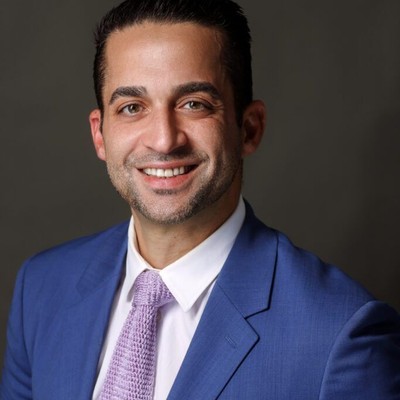
Written by J&Y Law — Los Angeles Car Accident Attorney · Cal Bar #SBN 250679 · Reviewed by Yosi Yahoudai, J.D. · Adapted for CaseCompass
1Why Los Angeles Car Accident Claims Are Different▼
Los Angeles has the highest crash volume of any county in California — over 54,000 injury accidents per year. The high density of commercial vehicles, rideshare drivers, and delivery fleets on the 405, 10, and 101 means that many crashes involve multiple potentially liable parties. Identifying all available coverage before filing a single claim is critical. An attorney who only looks at the at-fault driver's policy may miss corporate vehicle policies, umbrella policies, or uninsured motorist claims that can significantly increase total recovery.
2How California Pure Comparative Negligence Affects Your Case▼
California's Pure Comparative Negligence rule allows you to recover compensation even if you were partially at fault — but insurance companies exploit it aggressively. Adjusters are trained to find any evidence of the victim's fault and apply it to reduce the settlement. A recorded statement made before you understand your rights, a social media post, or even your own description of the accident to the ER nurse can be used to inflate your fault percentage. An attorney preserves your statement, controls the narrative, and challenges improper fault assignments.
3What We See in Practice: Early Offers and MMI Timing▼
Insurers make first offers in Los Angeles car accident cases within days — often before the victim has reached Maximum Medical Improvement (MMI), before imaging has been reviewed, and before the full scope of injury is understood. Accepting a pre-MMI offer is one of the most expensive mistakes accident victims make. Future surgery, physical therapy, lost earning capacity, and permanent impairment are all excluded from early offers. We routinely see clients who accepted early offers for soft-tissue injuries that later required surgery — permanently waiving their right to those costs.
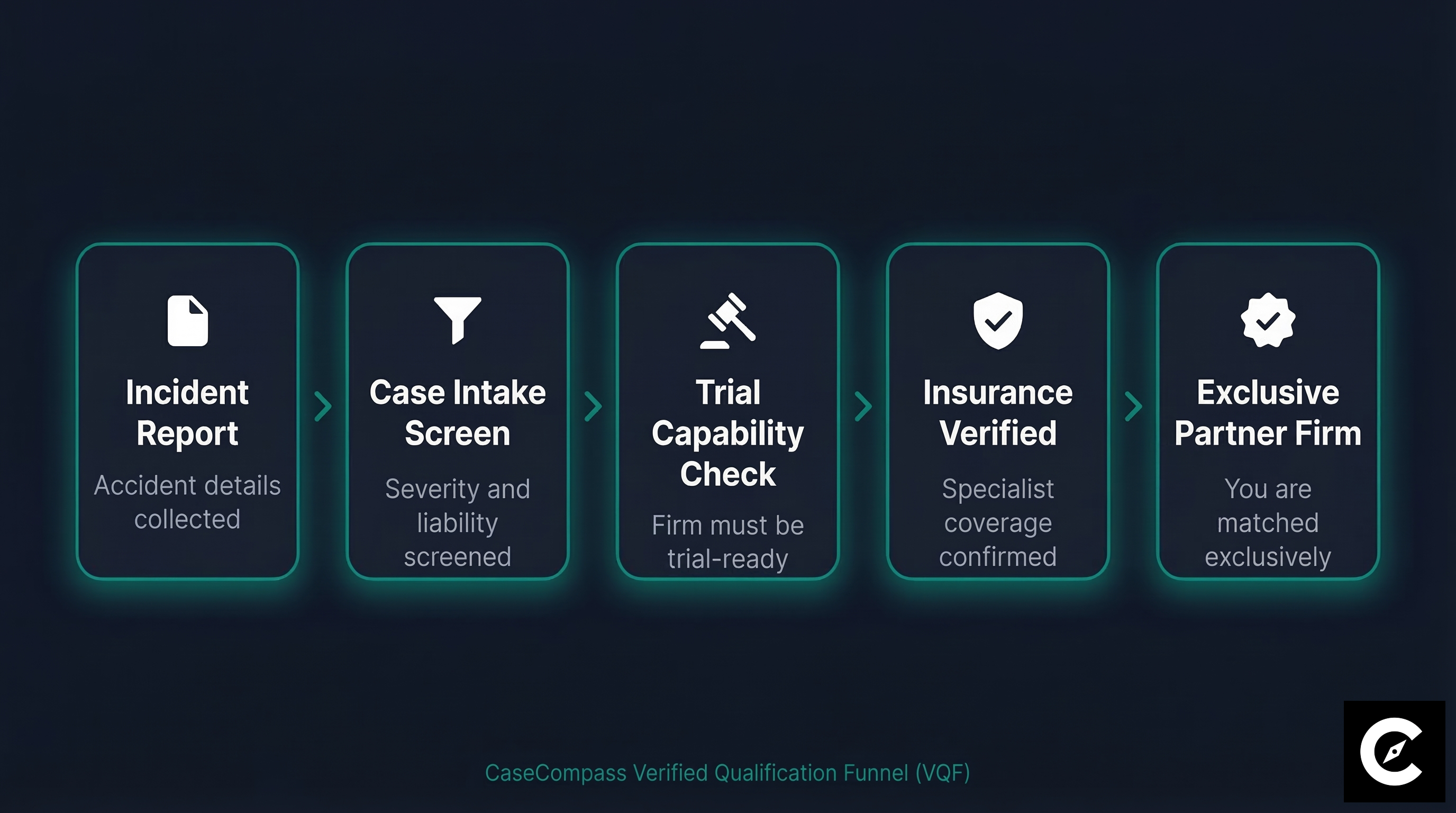
How We Match You with a Verified Firm
Not all law firms are qualified to handle serious injury cases. As shown in our qualification pipeline below, CaseCompass strictly filters incoming cases to ensure you are connected exclusively with a highly-vetted, specialized verified partner firm capable of taking your case to trial if an insurance company refuses to settle fairly.
How much is your case worth in California?
Statewide settlement data by injury type, verified by Yosi Yahoudai, J.D..
| Metric | Value | Source |
|---|---|---|
| California statute of limitations — personal injury | 2 years from accident date | statuteCalifornia Code of Civil Procedure § 335.1(as of 2025) |
| California minimum bodily injury liability (as of Jan. 1, 2025) | $30,000 per person / $60,000 per accident | statuteCalifornia Vehicle Code § 16056 (AB 1107)(as of 2025) |
| Soft tissue injury (whiplash) — estimated settlement range | $3,500 – $15,000 | firm dataCalifornia Superior Court closed claim data · Reviewed by Yosi Yahoudai, J.D. · CA Bar #250679(as of 2025) |
| Broken bones / fractures — estimated settlement range | $25,000 – $75,000 | firm dataCalifornia Superior Court closed claim data · Reviewed by Yosi Yahoudai, J.D. · CA Bar #250679(as of 2025) |
| Spinal surgery / fusion — estimated settlement range | $100,000 – $500,000 | firm dataCalifornia Superior Court closed claim data · Reviewed by Yosi Yahoudai, J.D. · CA Bar #250679(as of 2025) |
| Traumatic Brain Injury (TBI) — estimated settlement range | $250,000 – $1M+ | firm dataCalifornia Superior Court closed claim data · Reviewed by Yosi Yahoudai, J.D. · CA Bar #250679(as of 2025) |
| LA County injury crashes per year | 54,347 | .gov ✓CHP SWITRS (switrs.dot.ca.gov)(as of 2022) |
| DMV SR-1 filing deadline (injury or $1,000+ damage) | 10 days from accident date | statuteCalifornia Vehicle Code § 16000(as of 2025) |
Settlement ranges are estimated from Los Angeles County Superior Court closed claim data, 2020–2025. Reviewed by Yosi Yahoudai, J.D., California Bar #250679. Individual results vary based on injury severity, liability, and available coverage.
Common Mistakes to Avoid
- 1
Mistake #1: Waiting more than 24 hours to see a doctor. Adrenaline masks pain for hours. A treatment gap of 3 or more days is routinely used by California insurers to argue that injuries were pre-existing or minor and not caused by the accident. See a doctor the same day
even urgent care or an ER visit creates the causal record you need.
- 2
Mistake #2: Giving a recorded statement to the at-fault driver's insurer. The opposing insurer is an adverse party. California law does not require you to cooperate with their investigation. In our experience, recorded statements made in the first 72 hours
before symptoms fully develop — are used verbatim to dispute injury severity for the entire life of the claim. Decline any recorded statement request until you have retained counsel.
- 3
Mistake #3: Accepting the first settlement offer. First offers in Los Angeles auto claims typically reflect only documented ER bills
excluding future care, lost earning capacity, and non-economic damages entirely. The gap between a first offer and actual case value averages 40%–60%. Do not sign any release or accept any offer without first reaching Maximum Medical Improvement (MMI) and consulting an attorney.
- 4
Mistake #4: Assuming fault is obvious and not preserving evidence. Insurance adjusters assign fault in the first 10 days, often before victims have reviewed the police report. Surveillance footage from nearby businesses, traffic cameras, and dashcams are typically overwritten within 30–72 hours. An attorney can send a preservation demand letter immediately to prevent evidence destruction.
- 5
Mistake #5: Not reporting the accident to your own insurance company. California law requires you to report accidents to your insurer, even if you were not at fault. Failing to report promptly can void your own uninsured/underinsured motorist (UM/UIM) coverage
which matters significantly if the at-fault driver is underinsured. Report to your insurer within 24 hours, but do not give a recorded statement to anyone without counsel.
Why Work With a CaseCompass Attorney
No upfront cost. No obligation. Just answers.
Your Consultation Is Always Free
Every attorney on CaseCompass works on contingency — you pay nothing upfront, and nothing at all unless your attorney wins or settles your case.
Government-Sourced, Attorney-Verified
Every guide is built from official state records, federal statutes, and government data — then reviewed by a licensed California attorney with a verified clean disciplinary record.
Re-Verified Every 90 Days
Content is reviewed on a 90-day cycle with the reviewing attorney's name and Bar number listed transparently on every page.
24/7 Intake — English & Spanish
Every CaseCompass partner firm provides round-the-clock intake in both English and Spanish so you can get answers the moment you need them.
Your Privacy Is Protected
We never share your personal information without your explicit consent — your eligibility check is free, confidential, and carries zero obligation.
More Help
How to Choose the Right Lawyer
Bar verification, consultation questions, red flags, and contingency fee structures under California law.
Find a Trusted Auto Body Shop
Vetted collision repair shops in Los Angeles — insurance-approved and independently rated.
Lowball Settlement Offers
How to detect and counter a lowball insurance offer after your accident.
Insurance Claim Denied?
Steps to take when your insurance company denies or undervalues your claim.
Frequently Asked Questions
What should I do immediately after a car accident in Los Angeles?▼
Call 911 and wait for the police report. Photograph both vehicles, all damage, your injuries, and the scene. Collect the other driver's insurance information. See a doctor the same day. Do not give a recorded statement to any insurer before speaking with an attorney. California law does not require you to cooperate with the opposing insurer.
How long do I have to file a car accident claim in California?▼
California gives you 2 years from the accident date to file a personal injury lawsuit under CCP § 335.1. If a city or county vehicle was involved, you may have only 6 months to file a government tort claim. Missing these deadlines permanently bars your right to compensation — contact an attorney as soon as possible.
Can I still recover compensation if the accident was partly my fault?▼
Yes. California uses Pure Comparative Negligence — you can recover compensation even if you were 99% at fault. Your recovery is simply reduced by your percentage of fault. For example, if you are found 20% at fault in a $100,000 case, you recover $80,000. Insurance companies use this rule aggressively to minimize payouts by inflating the victim's fault share.
What are California's minimum car insurance requirements in 2025?▼
As of January 1, 2025, under AB 1107, California drivers must carry at least $30,000 per person and $60,000 per accident in bodily injury liability coverage, and $15,000 in property damage liability. These minimums doubled from the previous $15,000/$30,000 limits. If the at-fault driver only carries minimum coverage and your damages exceed those limits, your own underinsured motorist (UIM) coverage can cover the gap.
What if the other driver was uninsured in California?▼
If you carry Uninsured Motorist (UM) coverage, your own policy covers your injuries up to your UM limits — even when the at-fault driver has no insurance or flees the scene. California requires insurers to offer UM/UIM coverage. If you declined it in writing, your options are limited to pursuing the at-fault driver personally, which is rarely fruitful. An attorney can review your full policy coverage.
How much does a car accident lawyer cost in Los Angeles?▼
Almost all personal injury attorneys in California work on contingency — you pay nothing upfront. They receive a percentage of the settlement (typically 33%–40%) only if you win. If you recover nothing, they receive nothing. There is no financial risk in having a free consultation.
How long does a car accident claim take to settle in Los Angeles?▼
Minor injury cases with clear liability often settle in 3–6 months. Cases involving serious injuries, disputed fault, or multiple parties can take 1–3 years, especially if litigation is required. The best time to settle is after reaching Maximum Medical Improvement (MMI) — the point at which your doctor determines your condition has stabilized — so that future medical costs are included in your demand.
Should I accept the insurance company's first settlement offer?▼
Almost never. First offers typically reflect only documented emergency room bills and exclude future care, lost wages, and non-economic damages. In Los Angeles, the gap between a first offer and final settlement value averages 40%–60%. Accepting too early permanently waives your right to future compensation, even if your condition worsens. Reach MMI and consult an attorney before signing any release.
Do I have to file a DMV report after a car accident in California?▼
Yes. California Vehicle Code § 16000 requires you to file an SR-1 report with the DMV within 10 days if anyone was injured or property damage exceeds $1,000 — regardless of who was at fault. Failure to file can result in suspension of your driver's license. You can file online through the California DMV website. This is separate from the police report filed at the scene.
Sources & Citations
- statute[1] California Code of Civil Procedure § 335.1 — Statute of Limitations ↗
- statute[2] California AB 1107 — Updated Minimum Insurance (Jan. 2025) ↗
- .gov[3] CHP SWITRS — LA County Crash Data ↗
- .gov[4] California OTS — Traffic Safety Data ↗
- statute[5] California Vehicle Code § 16000 — SR-1 Reporting Requirement ↗
Check My Case Value & Protect My Claim →
Free · No obligation · 24/7 intake open
⚡ Free · No Obligation
See If You Qualify in 60 Seconds
Step 1 — Select accident type
What type of accident were you in?